
Alapaʻinuiakauaua

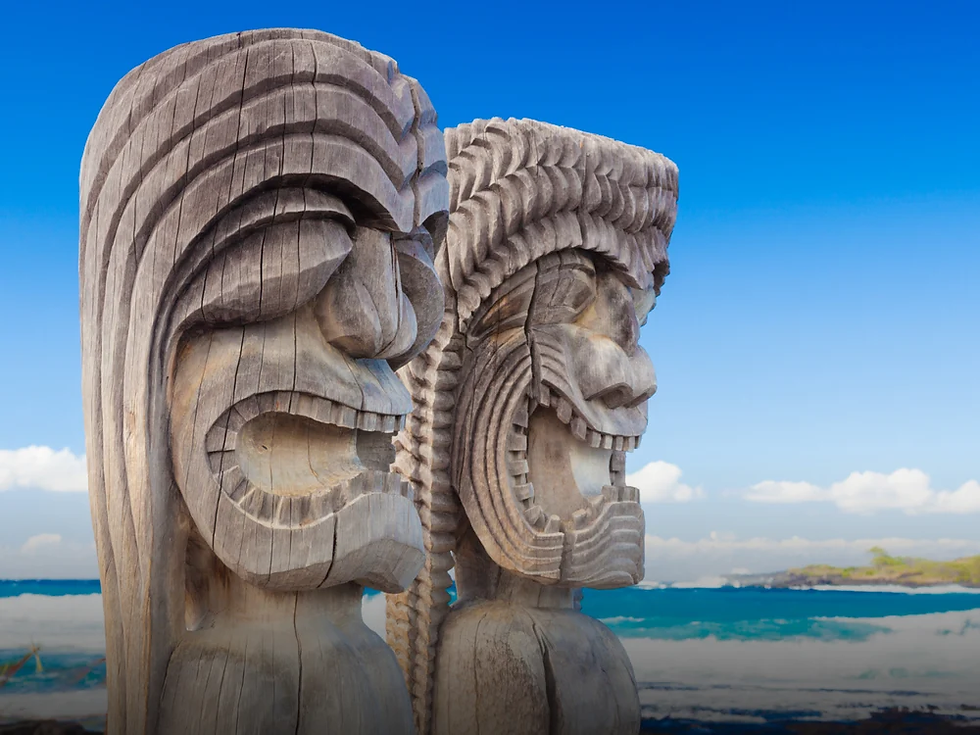
Kii: National Park Service
Ruling Chiefs of Hawai'i
Samuel Kamakau
Kamehameha Schools Press, Honolulu
Chapter V & VI
Pgs. 64-77
https://www.ulukau.org/ulukau-books/?a=d&d=EBOOK-CHIEFS.2.2.3&e=-------en-20--1--txt-txPT-----------
CHAPTER V
Keawe's Reign

Kii: NPS- Walsh
Keawe was the son of Keakea-lani. His father was Kanaloa-kapu-lehu and his [half] sister, Ka-lani-kau-lele-ia-iwi. Ka-lani-kau-lele-ia-iwi's father was also her cousin, named Kane-i-ka-ua-iwi-lani. These were the noted rulers of Hawaii. Her husband was Ka-uaua-nui-a-Mahi, and to them was born Alapaʻi-nui-a-Ka-uaua. Keawe was a famous ruler of Hawaii and was the ancestor of chiefs and commoners on that island. Keawe had many children by chiefesses and commoners. These are the children of Keawe who gained renown: Ka-lani-nui-ʻi-a-mamao (whose mother was Lono-maʻa-i-kanaka, a chiefess of Ka-ʻu and a descendant of ʻI), Keʻe-au-moku and his sister Ke-kela-o-ka-lani (whose mother was Ka-lani-kau-lele-ia-iwi), Haʻo, ʻAwili, Ka-lilau-moku, and Kumuhea (whose mother was Kane-ʻalai, a ruling chiefess of Molokai and a daughter of Luahiwa of the reigning family of Kauai). These were not the only children of Keawe, for he had many by chiefesses [of high rank], those of lesser rank, those without [rank], and by commoners. The descendants of Keawe spread from Hawaii among chiefs and commoners.
During Keawe's reign the whole of Hawaii was not united under him, for his rule was only over Kohala, Kona, and Ka-ʻu. He ruled over the many chiefs that were under him, and they took charge of Keawe's affairs. They were the ones who fought against the chiefs of Hilo. During Keawe's reign, Ka-ʻu was set aside for his son, Ka-lani-nuiʻi-a-mamao, and chiefly tabus were given to him. The chiefly tabu then belonged to the chiefs of Ka-ʻu, and the wohi tabu to the chiefs of Kona. So also did the chiefly tabus of the chiefs of Kona pass on to the son of Keawe. Keawe was a chief who was fond of traveling and he traveled about Maui, Molokai, Oahu, and Kauai. (Hence the saying, "Red-eyed was Keawe on Kauai, bald-headed was Keawe on Hawaii.") One noted thing that was said of Keawe was that he built a house to contain the remains of the chiefs at Honaunau, Hawaii, called Hale-o-Keawe.

Kii: 1823 William Ellis depiction of Hale o Keawe PUHO Archives
When Keawe died, his bones were enclosed in a wicker container. Those which were so enclosed were said to be in the kaʻai (ku i ke kaʻai). So the saying was, "Keawe returned and remained in the kaʻai"
(Hoʻi o Keawe a ku i ke kaʻai). Before he died he commanded that the government belong to his sons, Ka-lani-nui-ʻi-a-mamao and Keʻe-au-moku; Ka-lani-nuiʻi-a-mamao to be ruling chief of Ka-ʻu and Keʻe-au-moku of Kona and Kohala,
While Alapaʻi-nui-a-Ka-uaua was living on Maui with Ke-kau-like, ruler of Maui, he heard that Keawe, chief of Hawaii, was dead. Ke-kau-like was his half-sister's (Ke-kuʻi-apo-iwa-nui) husband, and his brother-in-law. Ke-kuʻi-apo-iwa-nui-a-Ka-lani-nui-kau-lele-ia-iwi, his half sister, was the wife of Ke-kau-like and she was the first-born child of Ka-lani-kau-lele-ia-iwi by Ka-ʻula-hea-nui-o-ka-moku. There was another reason why Alapaʻi-nui-a-Ka-uaua lived with his half sister on Maui—the death of his father, Ka-uaua-nui-a-Mahi, at Mahiki by the hands of the Hilo chiefs. After Keawe's death, Alapaʻi-nui-a-Ka-uaua thought of going to Hawaii to make war against the chiefs. When he made war against the chiefs of Kohala and Kona, he took them captive and became ruler of Kohala and Kona. Ke-kau-like heard of his victory over all of the chiefs of Kohala and Kona, therefore he desired to make war against Alapaʻi and return the government to the chiefs whose land it was. Alapaʻi won this victory but the warriors of Ke-kau-like went around Hawaii and interfered with Alapaʻi's wish to conquer the whole of it. Because Ke-kau-like fought against Alapaʻi frequently, Alapaʻi was unable to take captive the chiefs of Hilo and Kaʻu.*
CHAPTER VI
Hawaii Under Alapaʻi-nui

Kii: Keola Magazine Jan Becket - Kohala view
It was during the time of the warfare among the chiefs of [the island of] Hawaii which followed the death of Keawe, chief over the whole island (Ke-awe-i-kekahi-aliʻi-o-ka-moku) that Kamehameha I was born.* Moku was the ruling chief of Hilo, Hamakua, and a part of Puna; Keʻe-au-moku of Kona and Kohala. Alapaʻi-nui, son of Ka-uaua, was living at the time on Maui with the ruling chief Ka-lani-kuʻi-hono-i-ka-moku, [half] brother of the chiefess Ke-kuʻi-apo-iwa-nui. When Alapaʻi heard that the chiefs were stirring up trouble, he went to war on Hawaii against these chiefs, was victorious in battle against them, slew them, and united the island under his own rule. Ka-lani-ʻopuʻu and Keoua (the sons of the two sons of Keawe), who were then children, he brought up to be commanders of his host.
Ke-kau-like, also called Ka-lani-kuʻi-hono-i-ka-moku, the ruling chief (mo-i) of Maui mentioned above, was then living at Kaupo engaged in building luakini heiaus for his gods. He built Kane-malo-hemo at Popo-iwi, and the war heiaus (mamala koa), Loaloa and Puʻu-makaʻa at Ku-munui and Pohoʻula. This Ke-kau-like so delighted in war that he sailed to attack Hawaii. The fighting began with Alapaʻi at Kona. Both sides threw all their forces into the fight. Ke-kau-like cut down the trees throughout the land of Kona. Obliged to flee by canoe before Alapaʻi, he abused the country people of Kekaha. At Kawaihae he cut down all the coconut trees. He slaughtered the country people of Kohala, seized their possessions, and returned to Maui.
When Alapaʻi heard how cruelly the chief of Maui had treated the people of Hawaii he felt indignation on their account and determined to carry the war into Maui. He therefore consulted his leading chiefs,
It was during the time of the warfare among the chiefs of [the island of] Hawaii which followed the death of Keawe, chief over the whole island (Ke-awe-i-kekahi-aliʻi-o-ka-moku) that Kamehameha I was born. Moku was the ruling chief of Hilo, Hamakua, and a part of Puna; Keʻe-au-moku of Kona and Kohala. Alapaʻi-nui, son of Ka-uaua, was living at the time on Maui with the ruling chief Ka-lani-kuʻi-hono-i-ka-moku, [half] brother of the chiefess Ke-kuʻi-apo-iwa-nui. When Alapaʻi heard that the chiefs were stirring up trouble, he went to war on Hawaii against these chiefs, was victorious in battle against them, slew them, and united the island under his own rule. Ka-lani-ʻopuʻu and Keoua (the sons of the two sons of Keawe), who were then children, he brought up to be commanders of his host.
Ke-kau-like, also called Ka-lani-kuʻi-hono-i-ka-moku, the ruling chief (mo-i) of Maui mentioned above, was then living at Kaupo engaged in building luakini heiaus for his gods. He built Kane-malo-hemo at Popo-iwi, and the war heiaus (mamala koa), Loaloa and Puʻu-makaʻa at Ku-munui and Pohoʻula. This Ke-kau-like so delighted in war that he sailed to attack Hawaii. The fighting began with Alapaʻi at Kona. Both sides threw all their forces into the fight. Ke-kau-like cut down the trees throughout the land of Kona. Obliged to flee by canoe before Alapaʻi, he abused the country people of Kekaha. At Kawaihae he cut down all the coconut trees. He slaughtered the country people of Kohala, seized their possessions, and returned to Maui.
When Alapaʻi heard how cruelly the chief of Maui had treated the people of Hawaii he felt indignation on their account and determined to carry the war into Maui. He therefore consulted his leading chiefs,was Ke-kuʻi-apo-iwa, daughter of Kekela and Haʻae, both of whom belonged to families of chiefs. His father was Keoua, younger brother of Ka-lani-ʻopuʻu, Ka-makaʻi-moku being the mother of both. It was the custom from ancient times among the chiefs of Hawaii for the chief of one island to give a child to the chief of another island. This is the reason why Ka-hekili has often been called the father of Kamehameha, for chiefs of Hawaii and Maui were closely related, and this is why the twins Ka-meʻe-ia-moku and Ka-manawa, who were the children of Ke-kau-like, ruling chief of Maui, were made tabu to live on Hawaii as associates for the child of Ka-hekili. In the chant of Ke-aka, wife of Alapaʻi, ruling chief of Hawaii, it is said that Kamehameha was born in the month of lkuwa:
He ua lokuloku no Ikuwa ke ʻliʻi. Like the heavy rain of Ikuwa is
the chief.
Another chant places the time of birth in Makaliʻi:
Ke kukuni aku la i ka lani nui Intense is the heat in the vast
heavens.
O Makaliʻi ka haoa la wela To Makaliʻi belong the intensely
warm days,
Hanau mai ka lani la, he aoa. In which was born the chief, a
fighter.
It is said that there was rain, thunder, and lightning on the night when Kamehameha was born. Clearly this was in Ikuwa, the month of rain, thunder, and lightning, corresponding to our February or the first part of March.
Because of her weakened condition after the birth of her first-born child, Ke-kuʻi-apo-iwa did not accompany Alapaʻi's expedition to Maui. After it was learned that Nae-ʻole was the person who had taken the child, he was made the child's guardian, and his younger sister, Ke-ku-nui-a-lei-moku, was appointed his [the child's] foster mother. Until Kamehameha was five years old he was brought up at Halawa, an inland region of Kohala, and then Naeʻole returned the child to Alapaʻi, ruling chief of Hawaii. Alapaʻi placed him in charge of Ke-aka, and from that time she became his guardian.
Upon Ke-kau-like's return to Maui from his raid upon Kohala he made his home at Kaupo, intending to return to Hawaii and ravage Waipiʻo and the Hamakua district. But God ordered it otherwise, for he was seized with a violent illness, or epilepsy, called "Eyes drawn heavenward" (ka-maka-huki-lani), which defied the skill of doctors. Hence the succession to the land was settled at Mokulau in Kaupo, and Kame-hameha-nui, the older brother of Ka-hekili, was made ruler over the land of Maui.
Ke-kau-like had many children by his wives (wahine) and female retainers (haia wahine). Ka-uhi-ʻaimoku-a-Kama by Kaha-walu was the first born; Manu-haʻa-ipo, Ke-kau-hiwa-moku and Ka-ʻeo-[ku-lani] were the children of Holau; Kamehameha-nui, Ka-lola, Ka-hekili, and Ku-hoʻoheihei-pahu, of Ke-kuʻi-apo-iwa-nui; Na-mahana and Ke-kua-manoha', of Haʻaloʻu. But it was to Kamehameha-nui that the land descended, according to the command of Ke-kau-like. His mother's children were of higher rank than those of the other wives of Ke-kau-like. By the command of Ka-lani-ʻopuʻu given at Waioʻahukini, the rule over his lands in both Hawaii and Maui descended to his son Kiwalaʻo'. It was from the families of these two rulers that Kamehameha II and Kamehameha III were descended.
When Ke-kau-like heard that the ruling chief of Hawaii was at Kohala on his way to war against Maui, he was afraid and fled to Wailuku in his double war canoe named Ke-aka-milo.* He sailed with his wives and children ... his officers, war leaders, chiefs, and fighting men, including warriors, spearmen, and counselors., Some went by canoe and some overland, and the fleet landed at Kapaʻahu at the pit of ʻAi-hakoʻko' in Kula. Here on the shore the chiefs prepared a litter for Ke-kau-like and bore him upland to Halekiʻi in Kukahua. There Ke-kau-like died, and the sound of lamentation for the dead arose. Then, fearing the arrival of Alapaʻi bent on war, the chiefs cut the flesh from the bones of Ke-kau-like in order to lighten the load in carrying the body to ʻIao [for burial]. Placing the remains on a canoe, they sailed and landed at Kapoli in Maʻalaea and thence went on to Puʻuhele, to Kaluamanu, to Waikapu', to Wahanemaile, to Kaumuʻilio, to ʻAoakamanu, to Puʻu-ʻelinapao, to Kaumulanahu, to Kapohakoʻi, to Kalua, to Kekio, to Kama-ʻauwai, to Kahua, to Kaʻilipoe, to Kalihi, to Kaluaʻoiki, to Kihahale,stopped at Ahuwahine, laid him down at Loʻiloa, and put him away at Kapela. It was in the month of March, 1736 that Ke-kau-like died.
Alapaʻi sailed from Kohala on Hawaii with a great company of the chiefs of Hawaii, his war leaders, warriors, and the district chiefs of the island, to the great consternation of the chiefs of Maui. But when he landed at Mokulau in Kaupo [Maui] and heard that Ke-kau-like was dying, he gave up all thought of war and wished only to meet Ke-kau-like and his [half] sister Ke-kuʻi-apo-iwa-nui. He had heard that Ka-mehameha-nui had been chosen ruler over Maui and he had no desire to make war upon his sister's child. He landed at Kiheipukoa with all his chiefs and fighting men, commanded by the two leaders, Ka-lani-ʻopuʻu and Keoua, who acted as spies over the district for Alapaʻi. There the great chief, Alapaʻi, son of Ka-uaua son of Mahi, had a friendly meeting with Ke-kuʻi-apo-iwa-nui and her son Kamehameha-nui, to whom the land had descended, and with Ka-lola, Ka-hekili, and Ku-hoʻoheihei-pahu, the other children of Ke-kau-like by Ke-kuʻi-apo-iwa-nui.
While he was at Kihei, Alapaʻi heard that the ruling chief of Oahu was making war upon Molokai. Most of the chiefs of Molokai who were being thus ravaged by the ruling chief of Oahu were of Hawaii, children and grandchildren of Keawe. They had fled to the hills, and the ruling chief of Oahu had broken down the sea walls and destroyed their fishponds. Alapaʻi's sympathy was aroused, for these were his own brothers and children [relatives], and he made ready to go to their help on Molokai. He sailed from Maui and landed at Pukoʻo. From Waialua to Kaluaʻaha the fleet of Hawaii extended. The fighting was in progress at Kamaloʻo with Ka-pu-lei as the battlefield. There the forces of Hawaii, joined with those of Molokai, made a formidable array. The chief of Oahu, Ka-piʻi-oho-o-ka-lani, was encamped at Kalamaʻula, and the country from Kaunakakai to Naʻiwa was occupied by the chiefs and fighting men of Oahu. For four days the fighting went on with equal success on both sides, for Ka-piʻi-oho-o-ka-lani had drawn up his chiefs and fighting men side by side in the shape of a square like the threshold of a door. [With this formation he] drove into the opposing forces, while a right and left wing, formed of lines of men one behind the other in the shape of a flying fish, made attacking and protecting wedges at the two sides. His leaders on the left wing were Kaua-kahi-aliʻi-kapu, Kuʻihewa-kaʻokoʻa, Ka-ʻihi-kapu-a-mahana, Kawelo-iki-a-kulu, and Lono-nui-akea; on the right wing, Ka-hoʻowaha-kananuha, Ka-hoʻoaʻ-lani, Hua, and Moko-ka-laʻi. On the fifth day at Kawela the decisive battle was fought. Every able-bodied man came out of his house to fight. The Molokai forces attacked from the hills, those of Hawaii from the sea, while a great number landed from the fleet and fought on land. The battle began in the morning and lasted until afternoon. The ruling chief of Oahu found himself surrounded by sea and by land and hemmed into a small space. Ka-piʻi-oho-o-ka-lani died at Kawela below Kamiloloa, and many chiefs and fighting men were slaughtered, but some escaped and sailed for Oahu.
At the close of the war on Molokai, the chiefs were gratified by the return to them of their lands. Then Alapaʻi determined to sail to Oahu and take possession of that island; for he had heard that it was without a ruling chief, Pele-io-holani being at that time ruling chief of Kauai. Alapaʻi therefore sailed to Oahu with his chiefs and fighting men, accompanied by the chiefs of Molokai. Inquiring about the harbors on Oahu, he was told by those skilled in such things that, "Waikiki has a harbor, Waiʻalae has a harbor; these are both good harbors; at Waikiki and Honolulu live most of the chiefs." Alapaʻi attempted to land at Waikiki, but encountered so much difficulty that he decided to go on to Waiʻalae. Here he was driven back by the warriors of Ka-naha-o-ka-lani, the six-year-old son of Ka-piʻi-oho-o-ka-lani who had succeeded his father. Alapaʻi fled and put in at Koko, but was again driven back, and the same thing happened at Hanauma. Further information about landing places, perhaps from the experts of Molokai, revealed the fact that the coast of Oneawa in Koʻolau was an isolated place suitable for the landing of the expedition, and he sailed thither and beached between Kane-ʻohe and Kailua in Koʻolaupoko, at a good place for camping his numerous forces. There he made preparations for attacking Ka-naha-o-ka-lani. and appointed Ka-lani-ʻopuʻu and his brother Keoua captains of the army. A wonderful thing related of the child Ka-naha-o-ka-lani is that, in every engagement, he directed his forces by the voice alone, from the shoulders of his attendant.
Upon the arrival of Alapaʻi to war against Oahu, the [Oahu] chiefs sent for Pele-io-holani, chief of Kauai, to come to their aid. He accordingly arrived with his chiefs and fighting men and joined with those of Oahu to chastise the chief of Hawaii. Now there was a certain wise counselor named Na-ʻili, brother to Ka-makaʻi-moku the mother of Ka-lani-ʻopuʻu and Keoua, who was the chief in charge of Waiʻanae. Ka-makaʻi-moku was at this time living at Waikele. Said Na-ʻili to Pele-io-holani, "It would be best for you to put an end to this war and you two become acquainted with Alapaʻi," and he continued, "You can stop this war if you will, for the chiefs of Maui and Hawaii are related to you and that not distantly, for they are your own cousins," "Is Alapaʻi related to me?" asked Pele-io-holani. "You are a god, and on one side you are related," answered Na-ʻili. So Pele-io-holani consented to a meeting with Alapaʻi.At this time the fighting was going on at Kaulekola in Kaneʻohe, and Na-ʻili went down to stop the fighting. Approaching Ka-lani-ʻopuʻu and Keoua he kissed their hands and asked, "Where is your uncle?" Ka-lani-ʻopuʻu said, "Alapaʻi? He is at the seacoast, at Waihaukalua." "Then stop the fighting and let us go down to the seacoast." The two consented and went down with Na-ʻili to the coast with the chiefs and fighting men of Hawaii, and those of Oahu and Kauai also retired. There Na-ʻili met Alaipaʻi, and the two wailed over each other affectionately. "What brings you here?" said Alapaʻi. "I have come to stay the battle while you go to meet Pele-io-holani." "Does he consent?" "Yes," answered Na-ʻili. So Alapaʻi agreed to stay the battle and go to meet Pele-io-holani. Then Na-ʻili laid down the terms of the conference. They were to meet at Naonealaʻa. The Hawaiian forces were to remain in their canoes; not one was to land on pain of death except Alapaʻi himself, and he was to land without a weapon in his hand; likewise in the forces of Kauai and Oahu, if even a single chief bore arms, he was to die.*
It was the custom, when blood relatives went to war with each other and both sides suffered reverses, for some expert in genealogies to suggest a conference to end the war; then a meeting of both sides would take place. So it was that Pele-io-holani and Alapaʻi met at Naonealaʻa in Kaneʻohe, Koʻolaupoko, on Kaʻelo 13, 1737, corresponding to our January. The two hosts met, splendidly dressed in cloaks of bird feathers and in helmet-shaped head coverings beautifully decorated with feathers of birds. Red feather cloaks were to be seen on all sides. Both chiefs were attired in a way to inspire admiration and awe, and the day was one of rejoicing for the end of a dreadful conflict. The canoes were lined up from Kiʻi at Mokapu to Naonealaʻa, and there on the shore line they remained, Alapaʻi going ashore alone. The chiefs of Oahu and Kauai, the fighting men, and the country people remained inland, the chief Pele-io-holani advancing alone. Between the two chiefs stood the counselor Na-ʻili, who first addressed Pele-io-holani saying, "When you and Alapaʻi meet, if he embraces and kisses you let Alapaʻi put his arms below yours, lest he gain the victory over you." This is to this day the practice of the bone-breaking wrestlers at Kapua and at Naonealaʻa. Alapaʻi declared an end of war, with all things as they were before, the chiefs oi Maui and Molokai to be at peace with those of Oahu and Kauai, so also those of Hawaii. Thus ended the meeting of Pele-io-holani with Alapaʻi.
Alapaʻi returned to Molokai to straighten out matters between the chiefs and the country people and enable them to live at peace with the chiefs of Maui and Lanai. Upon arriving at Maui, he found that Ka-uhi-ʻaimoku-a-Kama, the oldest son of Ke-kau-like by his wife Kaha-walu, had rebelled against Kamehameha-nui, heir to the island. The occasion for this revolt came when stones were being carried for the building of the heiau of Wailehua. The counselor who incited him to rebellion was a kahuna named Pi-naʻau. He said to Ka-uhi, "Let the weak carry stones; the work for the strong is to establish themselves upon the land.," Said Ka-uhi, "What shall I do?" Pi-naʻau answered, "Go to war, stand at the head of the government." They therefore seized all the food at ʻAlamihi and kept it under the control of the fighting men of Ka-uhi, enough to support their needs until they reached the fortress at Kahili. Thus began the war against Kamehameha-nui.
Ka-uhi was a son of Ke-kau-like and a good soldier. He had led the attack in the wars carried on by Ke-kau-like, and was the commander-in-chief in the battles of his father's time. These were the battles of Kiʻi-mumuku and Kipuka-ʻohelo at Kamaʻole, and of Ka-eulu and Ka-hale-mamala-koa at Kaupo, by which he established peace for his father as ruling chief of Maui. Another name for Ka-uhi is Ka-uhi-covered-by-the-shadow-of-the-crecent-moon (Ka-uhi-pu-mai-ka-hoaka).
Kua was the name of Ka-uhi's kahu. He went to Alapaʻi and said, "I have come to you to demand the kingdom for my chief. Take your chief and make him chief of Hawaii." Alapaʻi said, "I consent, but first fetch your chief to confer with me; then, if all is well, I will take my chief to Hawaii as a child of the chiefs." Then Kua ascended the fortified hill of Kahili at midday. He was a man with sore eyes, red and bleary, and was recognized as he ascended the fortified hill. Ka-uhi met him and said, "What is your errand?" Kua answered, "Your uncle, Alapaʻi, has sent for you to come and confer with him. Then the kingdom will be yours; he will take Kamehameha-nui to Hawaii. That is my errand to you. So let us go down." Ka-uhi consulted his chiefs, kahunas, and soothsayers in regard to Kua's message. They answered, "To dream of canoes or of ʻulei berries brings no good luck. So it is with the omens of the day, if you meet the hunchback, the bleary-eyed, or the rainbow in front of your path. This man who has come to you is a double rainbow of ill-luck. That we can all see." Kua said, "O chief, let us go down. Do not heed this nonsense. True counsel is to be had at the sea. Come and speak with Alapaʻi." Ka-uhi answered, "I will not go down." Said Kua, "You will become a destitute chief; you despise my words when I come to secure the government for ourselves."
Ka-uhi with his war leader Ku-ka-ʻeʻa and other warriors opened the attack against Kamehameha-nui. It was a great battle from which the forces of Kamehameha-nui fled before those of Ka-uhi. Near the house of David Malo is a breadfruit tree on which the first victim of the battle was laid. There the fighting men of Kamehameha-nui were slaughtered. Kamehameha-nui fled to Alapaʻi's canoe. Alapaʻi said, "I thought that this was a family quarrel, but it seems to be a real war of rebellion!" Alapaʻi returned to Hawaii, taking Kamehameha-nui with him, and made ready to come back and overrun the place and take Ka-uhi prisoner. When Ka-uhi heard that Alapaʻi was returning to war with Maui, he sent a present to Pele-io-holani with the request that he come to help him hold Maui, and Pele-io-holani, ruling chief of Oahu, consented.
A whole year Alapaʻi spent in preparation for the war with Maui. It was in 1738 that he set out for the war in which he swept the country. What was this war like? It employed the unusual method in warfare of drying up the streams of Kauaʻula, Kanaha, and Mahoma (which is the stream near Lāhaināluna). The wet taro patches and the brooks were dried up so that there was no food for the forces of Ka-uhi or for the country people. Alapaʻi's men kept close watch over the brooks of Olo-walu, Ukumehame, Wailuku, and Honokawai. When Pele-io-holani heard that Alapaʻi was at Lahaina he gathered all his forces at Hono-kahua and at Honolua. At Honokawai an engagement took place between the two armies, and the forces of Alapaʻi were slaughtered and fled to Keawawa. There Alapaʻi heard that Pele-io-holani had landed at Honokahua and had an army stationed at Keawawa, and he disposed his forces, some on sea and some on land. Although Pele-io-holani had but 640 men against Alapaʻi's 8,440 from the six districts of Hawaii, there were among them some famous warriors, such as Hana, a warrior intimate of Pele-io-holani, Malama-kuhi-ʻena, Moko-ka-laʻi, Kulepe, ʻOpu-hali, Kuakea, Lono-nui-akea, Pa-i-kahawai, Kawelo-iki-a-kulu, and Ka-mahu-a-koaiʻe. Pele-io-holani intended to unite his forces with those of Ka-uhi, but Alapaʻi's men held Lahaina from Ukumehame to Mala on the north, and in attempting to aid Ka-uhi, Pele-io-holani became involved in difficulty.* The hardest fighting, even compared with that at Napili and at Honokahua in Kaʻanapali, took place on the day of the attack at Puʻunene. Pele-io-holani was surrounded on all sides, mauka and makai, by the forces of Alapaʻi, led by Ka-lani-ʻopuʻu and Keoua. The two ruling chiefs met there again, face to face, to end the war and became friends again, so great had been the slaughter on both sides . . .
Perhaps the reason for this friendliness on the part of the two chiefs was the close relationship that existed between them. Alapaʻi's mother belonged to Oahu. She was Ka-lani-kau-lele-ia-iwi-nui, a daughter of Kane-i-ka-ua-iwi-lani, who was the child of Ka-ua-kahi-a-kuaʻana-au-a-kane, the daughter of Ka-ʻihi-kapu-a-Kuʻihewa. Moreover Ka-lani-ʻopuʻu and Keoua were own sons of Pele-io-holani through their mother Ka-makaʻi-moku. While Kualiʻi was still ruling Oahu, she had come to visit her mother ʻUmi-ʻula-i-ka-ʻahu-manu, who was living at Waikele with her younger brothers, and it was at the water of Alele just above Waipahu in Waikele, ʻEwa, that Ka-lani-ʻopuʻu was begotten by Pele-io-holani. The ruling chiefs of Oahu wore as a neck ornament an ivory whale's tooth shaped like a bud (ʻopuʻu) ; the royal neck ornament of Hawaii was a tongue-shaped hook, like a tortoise-shell fish-hook. Pele-io-holani named the child Ka-lei-ʻopuʻu after the bud-shaped neck ornament of his father Kualiʻi. Thus he begot Ka-lei-ʻopuʻu.* Keoua he probably begot after he became ruling chief.
At the end of the war Kamehameha-nui became ruling chief of Maui. Pele-io-holani retired to Koʻolau on Molokai with his adviser Na-ʻili and his chiefs and fighting men. The counselors of both Hawaii and Maui boasted, "Pele-io-holani, the son of Ku, belongs to Hana!" [has done his work well] W. P. Kinaʻu the younger, who died recently, was a descendant of the rebel chief. Kamehameha-nui ruled Maui in peace, and Alapaʻi held the rule over Hawaii, to which he returned after affairs had quieted down on Maui. He had no occasion to renew the war on Maui as in the time of Ke-kau-like, the father of Kamehameha-nui. who was an ambitious chief, a lover of war and greedy for rule over Hawaii.
Alapaʻi was a good ruler, one who loved the common people. His lands he had inherited from his grandfather Mahi-ʻololi', the chief who led the battle of Ke-one-ʻula at Pohakuomaneʻo when the chiefess Keakea-lani was ruler. He did not take lands from the chiefs or the commoners. He honored his wives, made feasts for them, and gave them ornaments. The chiefess Ke-aka was his favorite among them. He used to travel about the island and make his home for a time in one place and then in another.
Alapaʻi lived for some years in Hilo, and it was while there that Keoua, called Ka-lani-kupu-a-pa-i-ka-lani-nui, fell ill of a lingering sickness at Piʻopiʻo adjoining Wailoa in Waiakea and died there in 1752. He was mourned by the chiefs with loud wailing and with swaying of the body (ma ka haʻa ana) in token of grief.† His older brother Ka-lani-ʻopuʻu was with his kahu Puna above Kalepolepo at the time. Puna was a chief and a famous soldier of Alapaʻi's time. He it was whom Ka-lani-ʻopuʻu urged to abduct Kamehameha I for it was rumored, perhaps justly and perhaps not, that Alapaʻi was responsible for the death of Keoua.
After this, began the strife between Ka-lani-ʻopuʻu and Alapaʻi. The war began on the night when Ka-lani-ʻopuʻu went to secure Kamehameha. The chiefs were all on the alert, watching the corpse of Keoua, among them Keawe-ʻopala, the son of Alapaʻi, Ka-meʻe-ia-moku, Ka-manawa, Keʻe-au-moku, and Keawe-heulu, all chiefs who were "children" of Alapaʻi, and brave fighters through whom Alapaʻi's rule had been established. Puna, the kahu of Ka-lani-ʻopuʻu, had a war canoe ready at a place between Piʻopiʻo and Kalepolepo. Ka-lani-ʻopuʻu took a small company with him, and a fight ensued in which he would have been killed save for the proximity of Puna and his war canoe, but Kamehameha was not secured. This was Ka-lani-ʻopuʻu's first battle in his struggle to secure the rule over Hawaii, which finally became his through the efforts of his friends and the younger brothers of Keawe-maʻu-hili.
Ka-lani-ʻopuʻu and Keoua were the hereditary heirs to the land of Hawaii, for it had belonged to their father, Ka-lani-nui-ʻi-a-mamao, and [his brother] Ka-lani-keʻe-au^-moku; but Alapaʻi had seized it through force of arms and had slain the inheritors. Alapaʻi was a chief of high rank. Ka-lani-kau-lele-ia-iwi was his mother as well as the mother of Ka-lani-keʻe-au-moku. His father was Ka-uaua-a-Mahi, whose father, Mahi-ʻololi', was executive officer (Kuhina kaua nui) for the chiefess Keakea-lani while she held the government of Hawaii.
After the fight at Kalepolepo there was another battle between Alapaʻi and Ka-lani-ʻopuʻu with their chiefs and soldiers at Paʻieʻie adjoining Puaʻaloa. Thereafter a great battle was fought at Kualoa and Mokaulele all the way to Mahinaakaka, at which Ka-lani-ʻopuʻu almost lost his life. Hemmed in on all sides, he slipped on the pahoehoe [smooth lava rock] and two men seized him, one on either side; but he put forth all his strength, killing four of the soldiers. When two more came up and seized him he held them off, one with one hand and one with the other, and chanted these words:
He moku Kaʻula i hoa me Niʻihau, An island is Kaʻula connected with
Niihau,
I kaulua ia Kawaihoa a Kane, On both are the waters brought
forth by Kane,
O kaulana a ka la i Halaliʻi la, The sun shines over Halaliʻi
there,
Hala ka la nalo ma Lehua, The sun passes on and vanishes
at Lehua,
Hiki ka molehulehu o ke ahiahi, The dusk of evening comes,Moe e no Kauai iluna ka la, Kauai sleeps ere the sun goes
down,
E ao ana no Lehua i ke kai. Lehua lies bright in the sea.*
[Paraphrased, the lines mean: These two men I am holding both have life from Kane. They are men in full strength. They are soon to die. Early death comes to them. Glorious in battle am I.] Ka-lani-ʻopuʻu's men were victorious that day, and the chief realized how powerful his following was in chiefs and fighting men and how strong he himself was to break men's bones with his hands.†
After this battle at Mahinaakaka, Ka-lani-ʻopuʻu ruled over Ka-ʻu and Puna, for he was a native of Ka-ʻu. There were the birth sands of his ancestors. Alapaʻi dwelt in Hilo for a year and then went to live in Waipiʻo. Shortly after, he and the chiefs moved to Waimea and others went by canoe to Kawaihae. From Waimea he went to Lani-maomao, where he fell ill. Later he moved to Kikiakoʻi in Kawaihae. There his illness became serious, and at Kikiakoʻi in the heiau of Mailekini, Kawaihae, he appointed his son Keawe-ʻopala to be ruler over the island.


Comments