
'O Niu
- Kuialuaopuna

- Feb 18
- 10 min read
Updated: Mar 3

Kii: Ku'ialuaopuna
Manaʻo ka poʻe Hawaiʻi ʻo ke kumu niu, ke kinolau o Kū ke akua,a aia kona mana i ke kumu. Wahi a ka poʻe kahiko o Kalapana a me Kaimu Makena, ua kanu ʻia nā kumu Niu Lelo mua ma uka aku o Kalapana, Puna, Hawaii. Ua hoʻonui ʻia kēia ulu lāʻau kahiko a hiki i Kahauale'a, kahi e pili ana i ka heiau kahiko 'O Wahaʻula, e kū ana ma kahi o Kalapana. Ua olelo ia, ua hele mai keia Lelo i mua o ke Alii Pa'ao, no Raiatea, Tahiti aku. ʻO Pa'ao nō hoʻi ke kahuna nāna i hoʻolaʻa a kūkulu hou i ka heiau ʻo Moa'ula i loko o ka marae mōhai mua ma Hawaiʻi. He ʻelua ʻano ʻano ma Hawaiʻi kahiko, ʻo ka Niu Hiwa me kona ili ʻōmaʻomaʻo a me ka iwi ʻeleʻele. He kapu kēia niu i nā wāhine, a hoʻohana ʻia e nā kāne no ka ʻoihana a me ka lāʻau lapaʻau. ʻO kēia ʻano iwi ka mea maʻamau i hana ʻia ai ka ʻawa o ka wā kahiko no ka inu ʻawa. ʻO ka Niu Lelo me kona ʻili ʻulaʻula a me ka iwi poepoe, he kapu ia i nā wāhine i mea ʻai, akā hiki i nā wāhine ke hoʻohana i ka lau, ka ʻala a me nā wahi ʻē aʻe o ia lāʻau. He nui ka wai o keia niu Lelo i loko o kona iwi poepoe. Ma Kaimu a Kalāpana, ua kālua ia ka iwi o ka niu lelo e na po'e kama'āina e ho'ohiwa i na apu a lākou, no ka ho'ohana ana i ka aha awa i ka wā kahiko. Eia ka manao no na poe Hawaii.
He mau inoa ko ka poʻe Hawaiʻi e hōʻike ai i nā pae ʻokoʻa o ka ʻiʻo o ka niu. ʻO ka Niu ʻŌʻio ke ʻano like me ka iʻa oio. He palupalu a keʻokeʻo ka ʻiʻo o ka Niu 'O'io.
ʻO ka Niu Haohao, he keʻokeʻo a ʻōpiopio ka ʻiʻo. ʻO ka ʻiʻo Niu ʻIlikole, he hapa ʻō. Ua oʻo loa ka ʻiʻo o ka Niu Oʻo, a ua maloʻo kona ʻili. ʻO ia ke ʻano no ka wa'u ʻana i ka ʻiʻo malo'o, a laila, ʻuwi i mea e loaʻa ai ka waiū e hana ai i ke kulolo, ka 'ai kaulana mai ʻō ā ʻō. ʻO ka Niu ʻOkaʻa, ke kaʻawale ʻana o ka ʻiʻo mai ka iwi, ʻaʻohe wai ko loko. ʻO ia keia i'o no ka manoʻi, a i ʻole ka ʻaila niu, kahi e ʻohi ʻia ai ka ʻiʻo, ua pōʻalo e ho'omaloʻo ai i ka lā ma nā pōhaku. ʻO Niu Iho ka niu e ulu ana me ka ʻōpuʻu keʻokeʻo i loko o ka iwi. ʻO ka Haku keia ʻōpuʻu keʻokeʻo. Ma keia manawa, puka aku ka niho ku mai loko aku o ka niu, o keia ke kupu. Ua haʻi ʻia mai keia moʻolelo ko Kalapana ulu nui, o Ka Niu Ho'okahi, e ke kamaʻāina o Kaimu. O Pookapu ka inoa o keia kupa.
Hawaiians know the coconut tree is the kinolau or body form of Kū our akua and this tree contains his mana. The old people of Kalapana and Kaimu Makena say the first Niu Lelo trees were planted in the upper back lands of Kalapana, Puna, Hawaii. This ancient grove was then extended to the area Kahauale'a, next to the old heiau called Waha'ula, which stood near Kalapana. It was said that this Lelo came before the chief Paao, who came from Raiatea, Tahiti. Paao was also the priest who re dedicated and rebuilt Moaula heiau into the first sacrificial marae in Hawaii. There were 2 varieties of niu in ancient Hawaiʻi, the niu Hiwa with its green husk and dark shell and niu Lelo. This niu Hiwa was kapu to women and used by men for ceremonial and medicinal purposes. This type of shell from the Hiwa, was what the apu awa were usually made of in ancient times for the drinking of awa. The Niu Lelo, with its reddish husk and round shell was kapu to women as food, but women could use the fronds, trunk and other parts of the tree. This niu Lelo held a lot of water in its round shell and the fibers are used to make cordage or aha, The kama'aina of old would kalua the shells of the miu Lelo in an imu to darken their color for ceremonial use if 'apu Hiwa was not available. The history of the first niu grove was told to me by Pookapu, a native of the land,
Hawaiians have names to indicate the distinct stages of the flesh of the coconut.
ʻŌʻio - Flesh is very young and soft like jelly

Kii: Antoniraj
Soft meat that can be scooped from young coconuts. He ʻono ka wai o ka niu haohao (song), delicious is the water of the young coconut with soft meat. This soft flesh is called ʻŌʻio and has a jelly, soft consistency similar to the flesh of the o'io fish. This stage, the ʻŌʻio nut has sweet water, gradually losing its sweetness and becoming more oily as the coconut matures. The piko of the hua on the outside of the husk is bulging outward. This indicates a full nut and the ʻŌʻio inside is just starting to form. This is the prized wai o ka niu haohao.
Lomi Ōʻio

Kii: Arthur Betts
'Ōʻio

Kii: Zachary Mertens
Haohao - flesh is soft and white and the shell is still white and young. Flesh is firmer than 'O 'io.

Ki'i: Nancy Collins
ʻIlikole - Flesh is half ripe and firm

Kii: Ku'ialuaopuna
Flesh in nut is half ripe. It is eaten raw with Pa'akai 'alaea, inamona and poi.
Pa'akai 'alaea

Kii: Glane23
Inamona- Kukui

Kii: Ku'ialuaopuna
Roasted i'o of the kukui
O'o- Flesh is hard, some wai inside, meat is solid, used for wa'u or grating and squeeze the grated meat to get milk.
These niu in photo below are Malo'o. There is water inside and meat is firm and hard. The niho hasn't broken through the skin yet. Good for making milk.

Kii: Shutter Stock
Ripe and mature nuts.
Outer nut is brown and dry, inside flesh of nut is fully mature and the inner husk is dry.
Wa'u Niu

Kii: Aw Marine
In the old days a shell was typically used to wa'u the meat from the shell. The grated meat is then squeezed to obtain the milk in order to make kulolo, haupia and other foods. The squeezed milk from the grated meat is called niu ā wali.

Kii: Visit Guyana
ʻuwī-To twist, squeeze the grated meat
The grated coconut is placed in the clean pulu fibers and rolled up. Squeeze the pulu and the milk will flow out.

ʻOkaʻa- Meat inside shell is old and dry. Meat can be detached from inside the shell and move around. Meat good for making oil.

Kii: Indiamart
These niu are old and the outer nut has numerous wrinkling on the husk. There is no wai within the nut.

Kii: Pascal Bastianaggi
The flesh separates easily from the shell, and there is no water. This is the stage of Niu 'Okaa used for manoʻi or coconut oil, where the dried old meat is scooped out and sun dried on rocks or a drying rack. In older Hawaii and other parts of the pacific, the scooped out meat was dried on coconut leaves in the sun.

Kii: Pascal Bastianaggi
The niu okaa are split in half and the nuts are sun dried. The meat is scooped out and left to shrink and dry in the sun. They are turned over and dried till the meat is like hard flakes.
Iho /Haku /Lolo / lolo niu

Kii: Ku'ialuaopuna
Haku is the sweet soft flower found inside the nut when the Niho ku or sprout emerges from the husk as a shoot. It's the pithy yellow/white sponge. As the niho grows into a leaf sprout the Haku fills the cavity of the shell.
Mahele o ka niu - parts of Kumu niu

Kii: Fast Growing Trees
Nī'au
Dried center rib of coco tree leaf- pulumi ni'au / to sweep floor

Kii: National Park Service
Hā niu
Heavy end of a coconut frond, base of frond that connects to kumu. This ha niu was use as a mea kaua in old Hawaii and other island in the pacific when hand weapons were not always availble. The Ha niu was trimmed to length like a machete and used as a striking weapon.

Kii: Creative Commons
Pani

Kii: ku'ialuaopuna
The bottom of a coconut when cracked off by blows around the base of the nut; it fits like a cover (pani).
Hāʻaʻa / 'a'a'a/ 'a'a lole

Kii: Ku'ialuaopuna
Cloth like sheath at base of ha niu or coco frond.
ʻAʻamoʻo- young cloth like sheath at base of coconut frond resembling gauze.

Kii: Ku'ialuaopuna
Puka Wai / Hipahipa

Kii: Trade India
Maka o niu, eye of a coconut - hipahipa
ʻAʻa pulu niu

Kii: Ku'ialuaopuna
The peeled husk is used to start fires in the imu and used to cook food like ulu, kalo, uala in an umu or cooking place, or in the making of aha or sennit. 'A'a or pulu are the fibers that are pulled from the inner side of the husk.
Husk the dried nuts, discard the shell and keep only the husks sections. Place each husk section in salt water and let them soak for two to eight weeks. You also may let the soak in the shallow part of the reef. If not, you'll need a bucket. Be sure to refill the bucket if the water level goes down.
Remove the husk sections from the salt water. Place one section on the large, flat rock and begin to beat with a wooden mallet to flatten. Beat from the center to the edges. Flip and repeat on the opposite side. Beating should loosen any "pulp" or other extraneous organic matter. Beat the rest of the sections. Remove as many long fibers from the pulp as possible and rinse. Find an area that is protected from the wind and allow the fibers to dry in the sun.
Separate the dry fibers into groups of five. Take three groups of five and braid these fibers together, holding the end with your toes. When they are about to run out, add a new group of five to each braid section until you've achieved the desired length.
Alternatively, you may twist the fibers together by rolling them with your palm along your thigh, adding new fibers as needed.

Kii: Hanahouhilo.com

Kii: Lauhalatrading.com
Pua niu

Kii: Get flowers daily
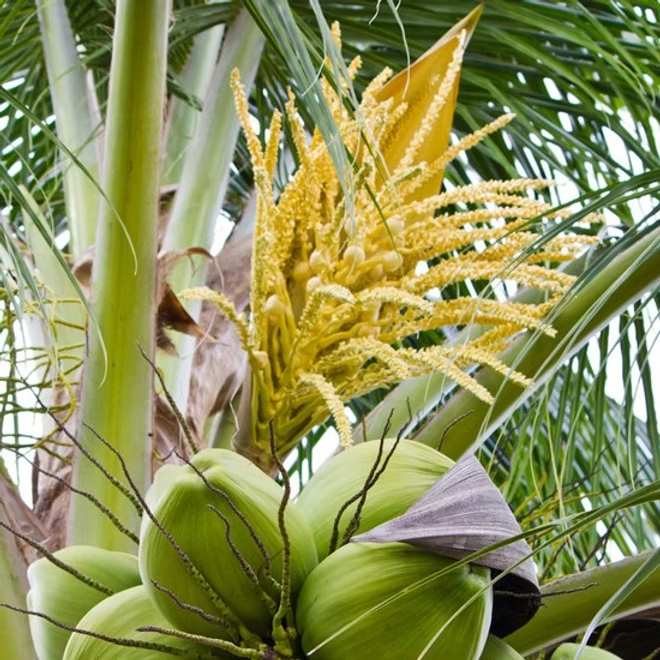
Kii: Cocofina
Coconut trees are able to produce coconuts without the need for pollination from other trees as they have both male and female flowers on the same tree. The flowers of the kumu niu contain both male and female reproductive organs. When the male flowers release pollen, it travels to the female flowers on the same tree, allowing for fertilization and the development of fruit, which eventually become coconuts. This is known as self-pollination or self-fertilization. As a result, coconut trees are able to reproduce and produce coconuts without the need for other trees nearby.
Hale pua niu, house where offerings of bananas, coconuts and awa were kept. These are to be offered in order to deify ( kaku'ai) a deceased person and make him into a mano, mo'o or any animal form.
lau niu

Older green lau niu

Kii: Nature Creations
Young lau niu
lauʻō

Kii: Alibaba
Lauʻō is the center leaf that is white in appearance and not yet opened these are leaves at the heart of the kumu.

Kii: Inday Sarisari
Iwi pūniu

Kii: BFT store

Kii: Life.ru
Holoaʻa (holowaʻa)

Kii: Ulrike Mosel

Kii: Monika Sommer
Holoa'a is the sheath that covers the pua or flowers of the niu. It resembles a waa.
ʻōniu

Kii: Black Box Guild
A sharp stick or spike to husk the coconut.
Lolokia

Kii: Circus Thuppaki
PInner Stem of the Coconut tree. It's a natural eatable, sweet in taste, and has got many health benefits. This can be extracted only after cutting the tree.iday
Here is a saying from the old folks "A very delightful thing is the water of the young coconut when swallowed, the throat cluck clucks as it slips and slides down"
Here is an old favorite Hawaiian song about our niu written by Bina Mossman.

Ka Wai O Ka Niu Haohao - Nui Haohao · Leina'ala Haili
Ka Niu Haohao
He ʻono lā he momoni lā, ka wai o ka niu haohao
A na koʻukoʻu ʻana i ka puʻu lā, he pakika he paheʻe ke momoni
He ua no ia kaulana lā, ma luna nei no kuʻu maka
Ka poli nei ka hiona lā, i ka wai o kahi aliʻi
Na wai, na wai nō ʻoe aʻe pakele aku, pakele aku
I ka wai, i ka wai o ka niu o ka niu haohao (niu haohao)
He maʻū maʻū maʻū i ka puʻu ke moni,
Kāohi kāohi mālie aʻe i ke kīleo, Kāohi kāohi mālie aʻe i ke kīleo
Hui:
He pakika, he pakika
He paheʻe, he paheʻe
He pakika i kahi wai o ka ʻāina nui
He pakika, he pakika
He paheʻe, he paheʻe
He pakika i kahi wai o ka ʻāina nui
---------------------------------------
Delicious to swallow, the water of the young niu
The throat sounds as the water slips and slides down
A well known water its is, here above my eyes
The appearance is heartful, the wai of the chiefs
Who can, who can escape you,
The water, the water of a young coconut
Cool and Refreshing to the throat when swallowed
And gently pressing on the palate, gently pressing the throat
Chorus:
It slips and slips
And slides and slides
It slips the water of this great land
It slips and slips
And slides and slides
It slips the water of this great land
 Source: - There were coconut trees in the backyard of the composer's home in Kalihi. One day in 1924, she recalled how fond she was of the young coconut meat and was inspired to write this song. Old Hawaiians believed the coconut tree was the kinolau of Kū and contained his mana. Deeply rooted in the earth, an Oʻahu legend says the Niu tree was planted by the early voyaging chief Pōkaʻi in the Waiʻanae region now known as Pōkaʻi Bay. There were 2 varieties in ancient Hawaiʻi. The niu hiwa with its dark green husk and black shell was kapu to women and used by men for ceremonial and medicinal purposes. The young coconut, "niu hiwa a Kāne" was used by the priests in divination. The niu lelo with its reddish yellow husk and brown shell was kapu to women as food, but they could use the fronds, trunks and other parts of the tree. The Hawaiians had names to indicate the distinct stages of the flesh of the coconut. 1) ʻŌʻio flesh has a jelly like consistency. 2) Haohao flesh is soft and white and the shell is still white. 3)ʻIli kole or ʻili ʻole flesh is half ripe. 4) Niu oʻo flesh is fully mature and the husk is dry. 5) Niu ʻakaʻa or ʻokaʻa is when the flesh separates easily from the shell and there is no water. This is the stage used for manoʻi or coconut oil. Edited by Dr. Barbara Price © Criterion Music Corp. Music clip by Gippy Cooke |
He mea hunehune mai ta rani mai e na kamaaina...
Eia ka manao no na oiwi, ke puka mai ka niho puaka mai loko mai ka piko o ke keiki, he o wahine no hoi ia. I ka puka ana o ia niho aki mai ka ili e ae, he o Kane no o ia. O ia ka! E malama o Wahine, e kapae te tapu o ka o Tane! He aha keia e na kamaaina akamai? Lelele mai kou manao ke loaa.


Comments