
Tahitian warfare
- Kuialuaopuna

- 7 days ago
- 63 min read

Oparree (Pare): Tahitian war-boats off the coast of the northern province. After William Hodge, artist on the Second Voyage. Dutch edition.
ANCIENT TAHITIAN SOCIETY
DOUGLAS L. OLIVER
1974 by The University Press of Hawaii Press
Open Access edition funded by the National Endowment for the Humanities / Andrew W. Mellon Foundation Humanities Open Book Program.
CHAPTER 12
WARFARE
Among the Society Islanders, in consequence of the influence of the climate, luxurious mode of living, and effeminacy of character, induced thereby, the obstinacy and the continuance of actual combat were not equal to that which obtained in other tribes; yet we learn from the frequency of its occurrence, and the deadly hatred which was cherished, that the passion for war was not less powerful with them than with the New Zealander or the Marquesian; and its consequent cruelties and demoralization were perhaps unequalled in any other part of the world. Their wars were most merciless and destructive. Invention itself was tortured to find out new or varied modes of inflicting suffering; and the total extermination of their enemies, with the desolation of a country, was often the avowed object of the war. This design, horrid as it is, has been [on occasion] literally accomplished: every inhabitant of an island, excepting the few that may have escaped by flight in their canoes, has been slaughtered; the bread-fruit trees have been cut down, and left to rot; the cocoa-nut trees have been killed by cutting off their tops or crown, and leaving the stems in desolate leafless ranks, as if they had been shivered by the lightning. (Ellis 1829:II, 494)
Warfare1 does indeed appear to have been a major preoccupation of the Maohis, involving social interactions of a most crucial nature and bringing about extensive changes in social relations. There may have been periods in Maohi prehistory when warfare served to maintain existing social relations, but during the era immediately before and after first European contact it was revolutionary in its social consequences and, quite possibly, in its conduct.
Full explication of the various causes of warfare must be postponed to later chapters, but it may be useful to list a few of the more immediate ones here.
Some writers, such as Moerenhout (1837:II, 31) and Andía y Varela (Corney 1915:271), included “economic” factors among the several causes of war: the desire, for example, for better land or for certain food when local resources were in short supply. In connection with the latter, Moerenhout asserted that when their own supplies gave out people living high up the valleys often attempted, sometimes by force, to obtain breadfruit from the longer-producing plains areas, and reciprocally that plainsmen would raid inland areas for plantains and other wild foods. Such forays, Moerenhout added, were generally on a small scale, usually having involved only “chefs subalternes” of the same tribal district, and thus were of no real concern to the districts’ sovereign chiefs. Some subsistence inequities may have occurred and have resulted in instances of localized raiding, but such conflict cannot have been very general or frequent, for, as noted in chapter 7, most Maohis resided in or had easy access to the same type of resource zone. Moreover, there is no record of any specific conflict of this nature developing into one large enough to figure in Maohi verbal traditions or European written records. Similarly, with respect to warfare resulting directly from desires for territory with richer economic resources, instances of such may indeed have taken place, but they were neither frequent enough nor large-scale enough to have been chronicled. Numerous boundary disputes are recorded as having developed into major armed conflicts, and, although “economic” factors may have underlain many of these, their more immediate causes were usually of a different nature.
Andía y Varela listed the capture of women as having been one of the main causes of warfare (Corney 1915:271), and oral tradition contains episodes of this kind. It is probably true that males outnumbered females somewhat, but in view of Maohi women’s relatively unfettered existences, except in certain dietary and ritual matters, it is unlikely that there was much widespread “capture” of them. Women undoubtedly figured among the causes of warfare, but not as mere pawns.
As already mentioned, disputes over boundaries are recorded as having developed into large-scale armed conflict (e.g., see Morrison 1935:173 ff.), and some of these were probably based on contention over economic resources. More often, however, boundary warfare resulted when one of the parties disregarded another’s frontiers as a gesture of political affront. As later chapters will describe, ambitions to extend or efforts to curb political power probably accounted for most of the larger, more devastating armed conflicts of the eras under study. Even gratuitous acts of cruelty and predation did not usually lead to large-scale warfare unless the political interests of socially important individuals became involved; and this was also true of instances of sacrilege, whether committed purposefully or otherwise.
But it will be more sensible to discuss these matters after some basis has been provided for an understanding of Maohi social relations, so I proceed now with a description of the more technical aspects of Maohi warfare.
Weapons and Uniforms
The principal weapons of the Maohis were spears, clubs, rasps, and stones. In addition, warriors sometimes carried “battleaxes” of pearl shell, but these were used more for dismembering fallen foe than for actual fighting. The Maohis also made bows and arrows, as noted above, but these were, inexplicably, used only for sport and hunting.2 (Figs. 12–1 through 12–6.)

Figure 12–1. Weapons: a, stingray rasp; b, bow; c, arrow; d, quiver and arrows. Drawing by J.
F. Miller. British Museum.

Figure 12–2. Weapons and drum: a, club; b, club; c, spear; d, drum; e, club. Drawings by J. F. Miller. British Museum.

Figure 12–3. Arrows and quiver. Quiver length 85 cm. Etnografiska Museet, Stockholm.

Figure 12–4. Unstrung bow, length 152.5 cm. Etnografiska Museet, Stockholm.
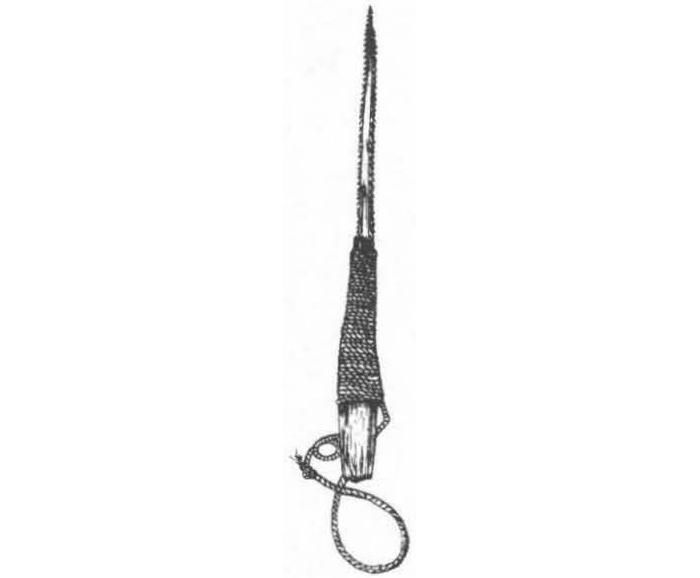
Figure 12–5. Dagger of hafted stingray tail, length 26 cm. National Museum, Washington.

Figure 12–6. Sling and stone. Bernisches Historisches Museum, Berne.
What most observers called “spears” were used for throwing, thrusting, and even clubbing and parrying. One type (pātia, tao), made of such hardwoods as ironwood, Alphitonia (toi), or coconut, was from twelve to eighteen feet long, about one and one-half to two inches in thickest diameter, and tapered to a pointed end. As was the case with other Maohi wooden weapons it was polished smooth but was not carved. Another type of spear differed from the pātia in being generally shorter and more slender, and in having a flat-bladed, lozenge-shaped fighting end. In some of these the butt end was rounded, in others pointed. A third type of spear (hoto ihe, maehae) was even shorter and had barbs of fishbones. Some flat-bladed spears were used also as clubs, but there were true clubs (‘omore), varying from long flat-bladed types to short bludgeons. Ellis reported that the handles of spears and clubs were covered, for surer gripping, with the resinous gum of the breadfruit tree (1829:II, 479).
Some fighting was done with the natural rasp provided by the serrated backbone of the stingray (‘aero fai) drawn across a foe’s body. Another fighting rasp consisted of a single or forked stick edged with sharks’ teeth (paeho).
Stones were hurled in battle, both by hand and by sling, with what has been described as great force and deadly accuracy (Ellis 1829:II, 490; Wilson 1799:364).
In addition to all these fighting implements the Maohis fashioned long spears out of hibiscus wood (pūrau), but these were used only for sport.
Ellis gave the following account of the offensive employment of spears and clubs:
The combatants did not use much science in the action, nor scarcely aim to parry their enemy’s weapons; they used no shield or target, and, believing the gods directed and sped their weapons with more than human force upon their assailants, they depended on strength more than art for success. Their clubs were invariably aimed at the head, and often, with the lozenge-shaped weapon, they would tapai, or cleave, the skulls of their opponents. Their spears they directed against the body, and the maui was often a deadly thrust, piercing through the heart. (1829:II, 489)
Cook, in describing a sham battle, praised the Maohis’ defensive skills especially:
Otou [Tu] who was present caused some of the Troops to go through with their exercize on Shore, Two parties first began with Clubs, but this was so soon over that I had no time to make observations upon it, they then went to Single Combat and went thro’ the Various Mithods of fighting with great allertness and parried off the blows, pushed &ca each combatant intended the other with great dexterity; their Arms were Clubs and Spears which they also used as darts. In fighting with the Clubs, I observed all side-blows were parried with the Club except those intended the legs which were evaded by leaping over them, a downright blow on the head they evaded by couching a little and leaping on one side, thus the blow would fall to the ground: they parried off the Spear or dart by fixing the point of their spear in the ground and holding of it before them in an inclined posission more or less elivated, according to the part of the boddy they saw their antagonist intended to make a push or throw his dart, and by turning their hand a little to the right or left turn off either the one or the other. (Beaglehole 1961:401–402)
Cook however was less impressed than Ellis was with the Maohis’ offensive tactics:
I thought that when one combatant had parried the blows &ca of the other, he did not take all the advantages which seem’d to me to accrue, as for instance, after he had parried of a dart he still stood on the defensive and suffered his Antagonist to take up another, when I thought their was time enough to have run him thro’ the boddy, but by such a step they might have exposed themselves to more danger than I could see or be aware of. (Beaglehole 1961:401–402)
According to Varela they handled their “cudgels” with “astonishing dexterity,” having been able to “… defend themselves against a sword without their opponent being able to get a cut in, skilful fencer though he be. I speak from the experience of a friendly trial which took place between Titorea … and a member of the storeship’s crew—a smart enough adept in fencing with the Spanish sword.” (Corney 1915:267)
A slingsman went to battle dressed only in loincloth (maro) and, sometimes, poncho (tiputa), but most other fighters wore one or more other items of body covering or headwear. Maohi “armor” consisted of a network of sennit cords wound around body and limbs “… so tight, as merely to allow of the unencumbered exercise of the legs and arms, and not to impede the circulation of the blood” (Ellis 1829:II, 500). This covering may have served somewhat to lessen blows of clubs and stones but did not defend much against a spear. Fine mats or sheets of bark cloth in place of armor were often worn in battle. Some men were so thickly girded with the latter that they were perceptibly impeded in their movements. “The very best things they possessed they always put on to go to war” (Orsmond, Notes on War). A most singular item of battle dress, and one having great exchange value, was the taūmi, or demi-gorget, a wickerwork breast covering decorated with shell, sharks’ teeth, and feathers (fig. 12–7).
Some fighters wore only a strip of bark cloth around their temples, others protected their heads with huge turbans of the same material, still others decorated their heads with showy feather headgear, and a few made themselves conspicuous to both friend and foe by wearing an imposing fau, described by Ellis as
… a cap fitted closely to the head, surrounded by a cylindrical structure of canework, ornamented with the dark glossy feathers of aquatic birds. The hollow crown frequently towered two or three feet above the head, and, being curved at the top, appeared to nod or bend with every movement of the wearer.

Figure 12–7. Gorgets: a, Bernisches Historisches Museum, Berne; b, British Museum.
This was a head-dress in high esteem, and worn only by distinguished men, who were generally sought out by the warriors in the opposing army. To subdue or kill a man who wore a fau, was one of the greatest feats. I have been often told, by a gigantic man who resided some time in my house, and was one of the warriors of Eimeo, that when the army of the enemy has come in sight, they used to look out for the fau rising above the rest of the army, and when they have seen one, pointing to it, animate each other by the exclamation, “The man with the fau; ha! whosoever shall obtain him, it will be enough.” But, however imposing in appearance these high helmets may have been, they afforded no defence; and although formed only of cane-work and feathers, must have been cumbersome. (1829:II, 499–500).
The relevance of the foregoing to social relations lies mainly in the relationship of weapons and battle attire to class status, a matter that will be discussed later on; but one may draw attention here to the unsuitability of some aspects of battle attire to the business of fighting. Armor and thick turbans undoubtedly served to reduce the effects of blows. Thick layers of body wrapping had the same effect but must have encumbered offensive fighting considerably. And as for the elaborate ornamental headgear, it could only have been a hindrance to fighting and surviving.
Training
The normal everyday activities of most Maohi males served to keep them in excellent physical trim for fighting, on land or on sea. Also, many of them engaged in sports which had the effect—and evidently even the avowed purpose—of preparing them for battle:
Their martial games were numerous; and to those preparatory sports, the youth paid great attention. The moto, or boxing, and the maona, or wrestling, were regarded as a sort of military drilling; but the vero patia, throwing the spear or javelin, and the practice of throwing stones from a sling, were the principal military games. (Ellis 1829:I, 294)3
But in addition, larger groups of males also occasionally engaged in practice maneuvers and sham fighting, probably more in preparation for specific engagements than as part of a peacetime policy of readiness.
Drilling was a standardized activity, as detailed in the following:
Standing upon an open field the drilling master said:
Toto‘o i te tahua ia mata tahua roa. | March out upon the long course. |
Toto‘o i te tahua ia mata tahua poto. | March out upon the short course. |
Tahi pae ia rupe-a-nu‘u. | One side for mountain-pigeon inland. |
Tahi pae i tai ia rupe-i-tai. | One side for mountain-pigeon coastwise. |
E ‘ori tatavi e ha‘a ta te va. | Emotion will dance, the waves [people] will work. |
E mataitai ta pua i te fau. | Fau flower will look on. |
E ‘ori te heiva ia orea. | Drilling will be the lively game. |
Na atua i uta e, a haere mai! | O gods inland, come forth! |
Na atua i tai e, a haere mai! | O gods coastwise, come forth! |
Na atua i ni‘a e a haere mai! | O gods above, come forth! |
Na atua i raro e, a haere mai! | O gods below, come forth! |
A haere mai ei atua a‘e i ta tatou | Come as gods in our amusement, |
Ei ha‘api‘i i teienei mau pipi | To teach these pupils |
I te tia raau. | The use of wood weapons. |
E moe i te Fatu, | Rest in the lord, |
E moe i te Fatu, Ta‘aroa, | Rest in the lord, Ta‘aroa, |
E tata te tapua ra‘au, | The user of the wood must strike, |
E ta i te vai o Tu‘. | Must strike the waters of stability (war). |
I noaa tana i‘a, | That he may obtain his fish, |
E vaevae roroa. | Long legs (slain men). |
Tana tiea e ‘ura! | This club is red! |
Then they would drill first with the club in six movements.
(1) E ‘ura teo; (2) e ‘ura teni; | (1) Exaltation red; (2) boastful red; |
(3) E ‘ura teo; (4) e ‘ura teni; | (3) Exaltation red; (4) boastful red; |
(5) E ‘ura pitara; (6) e ‘ura faau. | (5) Raising red; (6) striking red. |
E fa‘a‘a, e hoa ia Tane | Suit it, O friends, to Tane, |
Atua o te mau mea purotu, | God of beauty, |
Ia riro te hui ra‘atira | That the people may |
Ei papa rahi, | Become a great rock, |
Ei tahe vai pue i te ‘ite; | A freshet in dexterity, |
Ei ueue a vi | Become subduers, |
Ei manuu a horo; | Become fast runners; |
Ia poiri i vaho, | That darkness be [thrown] out, |
Ia marama i roto. | That the light be let in. |
They went through all their drilling thoroughly on land and sea. (Henry 1928:300)4
Cook described one episode of sham naval fighting, this one specifically arranged on his account:
I looked upon this to be a good oppertunity to get some insight into their Manner of fighting and desired Otoo to order some of them to go through the necessary manouvres. Two were accordingly ordered off, in one of them Otoo Mr King and my self went and Omai in the other. After we were out in the bay, we faced, and advanced upon each other and retreated by turns, as quick as the paddlers could move them; during this the wariors on the Stages flourished their weapons and played a hundred Antick tricks which could answer no other end that I could see than to work up their passions for fighting. Otoo stood by the side of the Stage and gave the necessary orders when to advance and when to retreat, in this great judgement and a quick eye combined together seemed necessary to seize every advantage that might offer and to avoide giving advantage. At last after advancing and retreating, to and from each other at least a dozen times, the two canoes closed, head to head, or stage to stage and after a short conflict, the troops on our Stage were supposed to be killed and we were board[ed] by Omai and his associates, and that very instant Otoo and all the paddlers leaped over board to save their lives by swiming. (Beaglehole 1967:I, 212–213)
The Spaniard Andía y Varela also described a sham naval fight which took place on the occasion of the visit of one chiefly personage to another. Because of a food scarcity in the host’s district, the guest of honor ordered supplies to be sent from his home district. When provisions arrived, carried by over two hundred canoes, some of them were left in the canoes to serve as a prize in a mock battle between local people and visitors—presumably a conventional kind of sportive encounter. In the foray which followed, “… many blows and hard knocks were dealt on either side.” The winner in this game was the side that ended up with the most booty. (Corney 1915:269)
Mobilization
Some large-scale armed conflicts commenced with stealthily executed attacks against unsuspecting enemies, but most Maohi warfare which the early Europeans chronicled began only after what amounted to public declaration and lengthy prologue, with the foe well warned if not well prepared. Mobilization involved both political and religious acts; in most instances the principal adversary on each side had to take steps to secure both human and supernatural assistance. Few leaders commanded enough wholly reliable manpower to be able to engage in large-scale battles without first taking steps to rally local support and secure allies. It seems to have been generally believed that no amount of human effort could achieve a victory without supernatural concurrence and assistance. Although it is impossible to learn, from available evidence, the relative decisiveness of these two factors in the thinking of most Maohis, some suggestive passages relating to this question will be quoted below. As a matter of fact, the political and religious steps toward mobilization were simultaneously pursued.
Even the most powerful tribal chiefs apparently felt it necessary to consult their principal supporters before committing themselves to full-scale war. This was usually done by convening a council of war,5 to decide whether to go to war and, if so, to apportion contributions in manpower and materials. Here is Henry’s account of the physical arrangements of such a meeting:
When at last the council met, the speakers sat in a central group, the sovereign and counselors sitting in a row at one end facing them and the chiefs and priests in a row to the right and to the left of the orators. The lower end of the two lines remained open for ingress and egress; but no one dared to cross the space between the sovereign and the orators, on pain of death. Outside of this official assembly sat an audience of the people, who had no voice in the meeting but felt a lively interest in what the orators said and were generally greatly impressed with their eloquence—the deliberations sometimes lasting over a day. (Henry 1928:297)
A passage from Moerenhout indicates that such meetings were no mere formalities:
These assemblies usually took place out of doors. The participating chiefs wore a special council-meeting garment (auhaana), a mat of fine quality which extended to the knees. The ra‘atira, those proprietors of large estates, whom I have already mentioned, were seated there with their superiors; and knowing full well that the latter depended upon their assistance they did not hesitate to express their own opinions. Usually both the pros and the cons were discussed in such meetings with clarity, emotion and eloquence. And, however bellicose the general populace may have been, the counsel of the majority of inferior chiefs sometimes forced the arii to give up his martial enterprises. (Moerenhout 1837:II, 32–33)
According to Ellis, the harangues of the orators, presumably both for and against war, were specimens of “… the most impassioned natural eloquence, bold and varied in its figures, and impressive in its effects.” Ellis continued:
I never had an opportunity of attending one of their national councils when the question of war was debated, under all the imposing influence imparted by their mythology, whereby they imagined the contention between the gods of the rivals was as great as that sustained by the parties themselves. A number of the figures and expressions used on these occasions are familiar, but, detached and translated, they lose their force. From what I have beheld in their public speeches, in force of sentiment, beauty of metaphor, and effect of action, I can imagine that the impression of an eloquent harangue, delivered by an ardent warrior, armed perhaps for combat, and aided by the influence of highly excited feeling, could produce no ordinary effect; and I have repeatedly heard Mr. Nott [another missionary] declare (and no one can better appreciate native eloquence), he would at any time go thirty miles to listen to an address impassioned as those he has sometimes heard on these occasions. (1829:II, 479–480)
As noted above, while the question of war and peace was being argued among political personages, priests sought signs from the spirits:
If in starting out to seek omens, the priests met with derision from a thoughtless group, it was regarded as a sign that defeat awaited the warriors, and that sufficed to cause abandonment of the project. If in seeking omens at night a priest chanced to touch something soft and pleasant with his toes, he said that the army would be victorious; but if his whole foot went in he said that the army would lose. If his face got covered with a spider’s web in the bushes he returned home feeling that he was not inspired and advised the sovereign not to venture in the project. If he paddled out in a canoe at night and a school of fishes jumped into his canoe, he said the enemy would thus fall into their hands. (Henry 1928:297)
In addition to such informal actions as these, more organized measures were undertaken to prognosticate and to secure the active assistance of friendly spirits by scrupulous performance of certain rituals and by gifts.
There may have been times in Maohi prehistory when each warring unit enjoyed the more or less exclusive support of this or that tutelar spirit, whose goodwill had to be continually courted, and perhaps, but not usually, competed for. Some of the armed conflicts of the eras under study may also have taken place under that kind of fixed supernatural auspices, but by then many other of the large-scale conflicts appear to have involved adversaries seeking approval and assistance from the same spirit, or set of spirits, and this of course required the offering of competitively attractive gifts.6 In fact, during the second half of the eighteenth century, the god ‘Oro appears to have achieved the status of a universal war god, whose favors were everywhere courted in connection with warfare. While most other spirits may have once been satisfied to receive offerings of pigs, dogs, fish, fine mats, and the like, ‘Oro preferred human beings; and his preference appears to have begun to be shared by several other spirits courted specifically for war. In any case, in the fullest descriptions that have survived concerning the ceremonial aspect of warfare, human sacrifice was a recurrent theme.
In one version (Ellis 1829:II, 478–479) a full-scale program of prebattle religious ceremonies lasted several days. The first three episodes of these events took place in conjunction with political meetings: (1) matea (awaken): a human sacrifice was offered to ‘Oro to “awaken” this deity and invite his presence and assistance; (2) maui fa‘atere (the throwing, or darting): another human sacrifice was offered (to ‘Oro also?), which served as a public declaration of war; (3) haea mati (tearing the peace-treaty emblem): still another human sacrifice was offered, figuratively representing the breaking off of any treaty relations that might have formerly bound the adversaries in a peace pact.
During these ceremonies priests continued to look for signs of the spirits’ attitudes toward the proposed war, as indicated, for example, by movements of the victims’ muscles. In the views of some writers these signs of a spirit’s attitude were regarded by the general populace as completely reliable and utterly decisive, when in fact they were not infrequently mere “juggling and contrivance” designed only to “… deceive the people into a persuasion that the god sanctioned the views of the king and government” (Ellis 1829:II, 503). As Moerenhout observed:
These oracles, however, almost always conformed to the politics of the chief; and it was especially on these occasions that the latter needed (the) priests. Though some, in fact, oppossed the ra‘atiras’ making war, it was rare that they resisted the gods’ will and no one would have refused to march when the sacrificers had promised victory. (1837:II, 33)
In this sense it was asserted by Moerenhout that the priests were masters of equivocation, having been cautious, for one reason or another, to interpret the signs in terms broad enough to accommodate to the shifting of political winds and even to the possibility of unfavorable military outcome.
Not so the shamans. When some spirit declared itself for war or peace through the instrument of a credible taura, its words were positive and usually decisive—which does not, of course, rule out the possibility that the behavior of some taura was, like that of the priests, influenced by politics. In any case, during the era under study the rise to influence of the war god ‘Oro was accompanied by a proliferation of shamans serving more or less exclusively as that god’s vehicle, and some of these achieved institutionalized positions of considerable influence over secular affairs. There is evidence for believing that when one of these shamans spoke out for peace or war even the most powerful secular leaders were swayed.
However the decision was arrived at, when war was decreed, there was set in motion another series of events, practical and ceremonial. Messengers were sent about the countryside announcing the decision to fight and calling upon the loyal leaders to mobilize their forces. In many cases mobilization required no longer than was necessary for the warriors to pick up their weapons and proceed to the assembly place; accounts speak of the continual state of readiness in which many men kept their weapons and battle dress. In other cases, however, there must have occurred long periods of preparation, especially when boats had to be built or converted to martial use. And during these proceedings steps were sometimes taken to remove the noncombatants—women, children, and the aged—to safer places.
Upon reaching the assembly place each leader and his immediate adherents encamped together and apparently retained their separateness as long as possible thereafter. If the force included the units of allies and not just members of a single tribe—and this was the case with most large-scale armed conflicts—the principal leaders of the separate units took the precaution of meeting together, in advance of their armies, to exchange compliments and each to assure the other of his intent. (Moerenhout 1837:II, 36)
Meanwhile another set of ceremonies took place, consisting of presentation by the secular leaders of valued objects—bark cloth, fine mats, pigs—to the priests, to compensate them for their unremitting efforts in securing the active assistance of spirits, including even winning over to their side the tutelars of the enemies (Ellis 1829:II, 481–482).
Following this was another set of ceremonies, often involving human sacrifice, in which the images of the supporting spirits were installed in temporary abodes as near to the actual fighting as possible, mainly in small marae erected on special canoes accompanying the fleet into battle. This was a most practical measure, since much large-scale combat usually took place at sea or near the shore. Also during some of these final prebattle ceremonies large quantities of food were consumed by the warriors, to sustain them during the ensuing fighting.7 These preliminaries completed, the forces then marched or paddled off to battle.
Before describing Maohi battle there remains the question of who actually took part in the battles and how often they occurred.
Fighting Personnel
Most sources agree that every able-bodied male capable of bearing arms was expected to join in the fighting;8 this presumably excluded the decrepitly aged and the very young (see Corney 1915:267), although there is no information available concerning the stage of development—in terms of physical aging or instrumental skills—considered minimal for joining in organized fighting. Cook and others held the opinion that roughly one-third of the total population of any community served as fighters in time of war, but this figure cannot throw much light on the question of the age limits of soldiering, because of uncertainties regarding the age and sex composition of the Maohi population as a whole. As noted in chapter 2, it was the impression of some writers that males outnumbered females in the total population, but none of the early observers troubled to make an exact count. In this connection, however, it is important to recall Ellis’ statement that the marked preponderance of males over females came about as a result of deliberate selection—that is, when parents were deciding which of their infants to allow to live they favored boys over girls mainly because of the former’s potential in warfare (1829:II, 495–496).9
But women were not necessarily prohibited from organized fighting:
When the men went to battle, the women generally remained; but some of them fearlessly attended their husbands to the field, and either followed in the rear, or fought in the midst of the ranks. They carried the same kind of weapons as the men, but frequently used only their nails and their hands. Many were slain in the field, or during the retreat. (Ellis 1829:II, 485)
Instances were also recorded of upper-class women actually leading troops into battle.
Frequency of Warfare
Turning now to the question of how often wars occurred, one finds in the sources such generalizations as, for example, that of Ellis, who stated that during the period 1797 to 1825 there were ten wars on Tahiti alone (1829:II, 477). By combining various chronicles of the period 1767 to 1814 (when Christianity itself became a major factor in inciting warfare), it is possible to distinguish for Tahiti and Mo‘orea some 15 large-scale battles involving at least hundreds of warriors and having clearly discernible beginnings and more or less decisive outcomes—admittedly not a very precise method for defining the phenomena under study, but the best I can do with the data available. And lest this estimate be accorded more accuracy than it deserves, it should be added that during the period encompassing these so-called battles a far greater number of smaller engagements—skirmishes, raids, and so forth—took place. In fact throughout this whole period, states of war, if not actual combat, prevailed more persistently than states of peace.
But it should also be recalled that the state of affairs existing on Tahiti after at least Cook’s first visit (1768) cannot be held typical of the preceding era, before the presence of European persons and implements began to influence Maohi polity and martial practice. And about that earlier era there has come down to us little information save ambiguous legend and biased chronicle.
One would like to learn whether there was some rhythm in Maohi warfare and some relation between climaxes of armed conflict and, say, the occurrence of seasons or the maturing of new generations. It seems obvious—and correspondingly tautological—that no political unit would have been in a position to wage Maohi-style warfare without certain minimum quantities of personnel and provisions, including goods for sacrifice. There are recorded instances of destitute and undermanned units striking out in desperation against more powerful adversaries, but most instances of the kind of deliberate warfare I have been describing seem not to have been undertaken without practical assurances of success. In view of the devastating nature of most Maohi warfare—a generalization that will be documented below—one might be led to conclude that a political unit decisively defeated in one battle would have to wait years before recovering enough strength to engage in another. This may indeed have been true in some cases, but there are other recorded instances of remarkably speedy comebacks, accomplished through industrious husbandry and shrewd diplomacy, as Cook remarked, after one eight-month absence from Tahiti:
I have already mentioned the improvements we found in the Plains of Oparre and Matavai: the same was observed in every other part into which we came, it seem’d to us allmost incredable that so many large Canoes and Houses could be built in so short a space of time as Eight Months, the tools which they got from the English and other Nations who have touched here have no doubt greatly accelerated the work and according to the old Proverb many hands make light work, for I shall soon make it appear there are no want of these; the Number of Hoggs too was a nother thing which struck our attention, but this is more easy accounted for, they might and certainly had a good many when we were here before but not chusing to part with any had conve(ye)d them out of our Sight, be this as it will, we now got (not only) as many as we could consume during our Stay, but some to take to Sea with us. (Beaglehole 1961:404)
And there are well-attested instances of chiefs, after having been soundly defeated in one devastating battle, being able to assemble a new and victorious alliance within a matter of months.
In other words, from this limited sample of history, Maohi material resources seem to have been abundant enough, and Maohi society populous and complex enough, to preclude any simple direct relation between large-scale armed conflicts and the passage of time—except in relation to the celebration of the annual first-fruit and harvest festivals, during which active hostilities are said to have ceased.
Fighting on Land
Most wars of any duration involved both land and sea engagements, although it now and then happened that an invasion from another island was entirely defeated and turned back at sea. I will begin with a description of fighting on land.
When preparations were going on for the kind of fighting on land that I have been describing, neither side appears to have been able to preserve much secrecy about its plans and arrangements. There was inevitably some movement across the frontiers, and a continual spreading of alarms. (For one thing, kinship ties invariably crossed and reduced the sharpness of political boundaries.) Also, there was posting of sentries—human and supernatural. In connection with the latter Henry reported the following:
When an invasion was expected, the priests went forth to the boundaries of their frontiers where the enemy would enter, and there dug little holes in which they placed ‘ura [feather] amulets as mariua (breakers), or merely prayed, which was called maunu (entrancing), considering these acts potent means of weakening the power of the enemy, who on their side were on the lookout for disturbed-looking ground, guarding against such hui marei (hosts of entangling demons). (1928:304)
Most large-scale land battles took place near the shore and in more or less open country, although ambuscade was sometimes practiced (e.g., see Ellis 1829:II, 486). The two armies usually approached each other to the accompaniment of beating drums and trumpeting conch shells. If the force was composed of allied units it was customary for their respective leaders to march toward the battleground arm-in-arm (pito), as a sign of their union. Similarly, the leader of each army subunit marched in pito with his principal supporters, who also remained with him in battle; and the same was the case with sets of close relatives and friends. (Henry 1928:304; Ellis 1829:II, 492)
According to Henry, each army was grouped into three segments—front ranks (viri aro), second ranks (āpo‘a viri, or hotuoa) and rear guards (tapono viri)—but it is not clear how this division related to an army made up of allied forces: that is, did each principal ally’s force keep together in the same viri, or was each force broken up into separate viri and thus combined with analogous segments of the other allied forces? (Though this question may seem to involve a mere technicality, its answer—unfortunately lacking—would provide useful data concerning the evolution of Maohi political relations.) Similar uncertainties obscure the reconstruction one is able to piece together concerning other aspects of army organization.
Men going into battle were differentiated according to function and social class. Certain men served as ‘battle shapers’ (tārai-aro), others as ‘priests’ (tahu‘a), still others as official ‘exhorters’ (rauti), and among the fighters there were specialist slingsmen as well as recognized ‘champions’ of close combat fighting (āito). Individuals from all classes of society—from highest to lowest—took an active part in fighting.
Battle shapers (tārai-aro), termed by Henry as “leaders” and “chiefs of the body of warriors,” were said by Ellis to marshall the forces for fighting (1829:II, 486). The battle attire and weapons of such “leaders” were described in detail:
The tarai-aro wore over an armor (haana-tama‘i) of closely braided coconut husk his best clothes, girded round the waist with sennit, the arms bare, and around the neck an elegant gorget of pearl shell mixed with various colored feathers and fringed with dog’s hair, upon his head he wore the towering black feathered fau (helmet) and upon his broad shoulder he proudly carried the tao [long spear]. (Henry 1928:299)
Their precise roles in combat—other than “marshalling the forces”—is nowhere described; nor is it clear whether only tārai-aro were attired with armor, gorget, and fau.
Priests were indispensable participants in battle. Some of them worked at soliciting supernatural assistance (tahu‘a-pure, haere pō), others prepared victims for sacrifice (‘upo‘o ‘aha), still others ministered to the wounded (tahu‘a ra‘au). They went to battle dressed in their official garb, but in addition to carrying out their specialized jobs they also bore weapons and fought like the others.
The job of exhorters (rauti) was described in some detail by Ellis:
The din and clamour of the deadly fury were greatly augmented by the efforts of the Rauti. These were the orators of battle. They were usually men of commanding person and military prowess, arrayed only in a girdle of the leaves of the ti-plant round their waist; sometimes carrying a light spear in the left, but always a small bunch of green ti-leaves in the right hand. In this bunch of leaves the principal weapon, a small, sharp, serrated, and barbed airo fai (bone of the sting-ray), was concealed, which they were reported to use dexterously when in contact with the enemy. The principal object of these Rautis was, to animate the troops by recounting the deeds of their forefathers, the fame of their tribe or island, and the interests involved in the contest. In the discharge of their duties they were indefatigable, and by night and day went through the camp rousing the ardour of the warriors. On the day of battle they marched with the army to the onset, mingled in the fury, and hurried to and fro among the combatants, cheering them with the recital of heroic deeds, or stimulating them to achievements of daring and valour.
Any attempt at translating their expressions would convey so inadequate an idea of their original force, as to destroy their effect. “Roll onward like the billows—break on them with te haruru o te tai, the ocean’s foam and roar when bursting on the reefs—hang on them as te uira mau tai, the forked lightning plays above the frothing surf—give out the vigilance, give out the strength, give out the anger, the anger of the devouring wild dog,—till their line is broken, till they flow back like the receding tide.” These were the expressions sometimes used, and the recollection of their spirit-stirring harangues is still vivid in the recollection of many who, when any thing is forcibly urged upon them, often involuntarily exclaim, “Tini Rauti teia,” this is equal to a Rauti.
If the battle continued for several successive days, the labours of the Rautis were so incessant by night through the camp, and by day amid the ranks in the field, that they have been known to expire from exhaustion and fatigue. (Ellis 1829:II, 487–489)10
I reproduce here a specimen of rauti chants, this one transcribed originally by Orsmond and possibly also translated by him, but evidently put in more polished (if less than faithful) form by Henry.
E ari‘i tei nia o te ueue a nu‘u, | There is a king above, who is the speaker of armies, |
O tapota a ra‘i. | The roller of the skies. |
A fanoi te tere, e te toa, e te auta‘ata. | Set about your errand, O warriors, O brave men. |
A ha‘apu i te tere, | Accomplish your errand, |
E te toa, i ni‘a ia Mou‘a-raha | O warriors, upon the flat mountain battlefield |
A Ta‘aroa, tuhi mate! | Of Ta‘aroa, whose curse is death! |
Auanei e huri ai | From the will send out |
I te vero moana. | An ocean storm battle. |
Auanei to paepae, e tau ari‘i, | Soon thy paving, O my king, |
E hi hee ai i te toto o te a‘e. | Will flow with the blood of the slain. |
Ei tao mato te nu‘u, | Let the army be as a cleft in the rock |
E mo‘o puapua tini tei roto; | Issuing out innumerable lizards; |
Ei ava afa te nu‘u | Let the army be an open passage |
E mao avai ava tei roto. | Within which is a furious shark. |
Horo i mua na te riri. | Rush forwards enraged. |
Te fetoitoi maira te au. | The current rage begins to swell. |
Taua e oua i roto | Let us leap into |
I te ripo o te au. | The vortex of the current (heat of warfare). |
Auanei e potu mai ai | Soon will burst forth |
Te mata‘i ia Raa-mau-riri, | The wind waging war of Raa-mau-riri (Sacredness-holding-anger), |
E tiu ma te toa, | A descriptive south wind, |
E parapu huri fenua. | Which ravages and devastates countries. |
E uira tutui ra‘i, | Lightning anger setting fire to the skies, |
E uira rapa ni‘a, | With lightning flashes above, |
Te tua o te uira | Upon the back of the lightning |
E vero tei muri, | Will come the storm battle, |
E vero ‘ino, e mata‘i ho‘i ri‘a. | An evil storm, an angry storm. |
A puta na te mata, a iriti; | If the eye get pricked, relieve it; |
A puta na te ‘ouma, a ha‘amahu; | If the breast get wounded, wear it; |
A pee atu te ofai a ha‘amahu; | If a stone strike you, bear it; |
A motu na te ‘iri, e tihi tau tana; | If the skin get cut, it is a professional ornament; |
E ‘ava ia na te taure‘are‘a; | These are opiates for the valiant; |
E ‘ava pua; e ‘ava re‘a; | Opiates fizzing and gay; |
E ‘ava te aninia; | Opiates that make dizzy; |
E ‘ava te tuiaroha; | Opiates that make faint; |
E ‘ava matapoiri; | Opiates that obscure the eyes; |
E ‘ava mau, te riri aitu; | Opiates indeed, the anger of the gods; |
E vahi iti e puta a‘e ai te ao, | A little more and day (victory) will dawn, |
E ta maa ‘ai te niu i | When we shall dine on coconuts |
E hopoi ia taua i te Po, | Take war to Hades, |
E fa‘aea i raro i te tumu o te niu. | And dwell beneath the coconut trees. |
(Henry 1928:306–307)11 |
Turning now to slingsmen, I noted earlier that these specialists wore only a breechclout and, perhaps, a poncho when fighting. Ellis has this to say about their employment in battle:
During the engagement, the parties often retreated, so that there was a considerable space between the ranks in these seasons, as when advancing to the onset. The slingers were then employed, and they often advanced in front of the ranks to which they belonged, and with boasting threats warned their enemies to fly or fall….
The most expert slingers were celebrated through the islands, as well as the most renowned among the warriors; and when one of these presented himself, a cry ran through the opposite ranks. Beware, or be vigilant, e ofai mau o mea—an adhering stone is such a one; or e ofai tano e ofai buai—a sure or a powerful stone is such an one…. The slingers were powerful and expert marksmen. (1829:II, 490–491)
According to Ellis every male capable of bearing arms did so, but there were among these
… a number of men celebrated for their valour, strength, or address in war, who were called aito, fighting-men or warriors. This title was the result of achievements in battle; it was highly respected, and proportionably sought by the courageous and ambitious. It was not, like the chieftainship and other prevailing distinctions, confined to any class, but open to all; and many from the lower ranks have risen, as warriors, to a high station in the community. (1829:II, 496)
Although the sources are not very explicit on this point, ‘aito appear to have been specialists in hand-to-hand combat, probably with spear and club.12
As noted above, persons from every social class engaged in fighting, but except for statements quoted above concerning the unimportance of social class in determining aito status, there are no data directly relating social class with combat specialty, battle priestcraft, or “exhorting.” The following statement by Henry is ambiguous, to say the least: “The warriors next in grade [to that of tārai-aro] wore their best clothes in the same manner, with or without armor, and the immense turban, which the terrible ‘omore [club] sometimes penetrated to the skull of the wearer; and they carried tiora and other spears according to their ranks” (1928:299).
Even more puzzling is the relation between combat specialty, social class, and command hierarchy. While the battle shapers acted to “marshall the forces” before battle, we are not informed about the number of them in relation to the entire force, nor about their actual roles, if any, once fighting had begun. Also, although it is plausible to infer from numerous observations that mobilization was accomplished under the direct supervision of each territorial unit’s “chief,” no such inferences can be drawn concerning the maintenance of that hierarchy in actual battle.
Several accounts also speak of armies having had a “general”—sometimes in the person of the unit’s tribal chief, or highest-ranking kin-Titleholder, but in some instances a noted warrior was assigned to that position by the latter. Presumably it was such men who “shaped the battle” (tārai aro) and gave the signals for the commencement of hostilities. But whether and how they continued to direct operations during actual fighting is not reported.
As a matter of fact, the whole question of “command” becomes rather pointless in view of the Maohis’ methods of fighting. According to Ellis, “The modes of attack and defence were various, and regulated by circumstances: there was either the aro [battle] viri, skirmishing of advanced portions of each army, or an arota, close engagement, when they fought hand to hand.” Ellis added that “Sometimes their attacks were made by night, but then they generally bore a rama, or torch. To ambuscades they seldom had recourse, though they occasionally adopted what was called the aro nee, or attack by stealth.” (1829:II, 486.) Henry and Moerenhout provided fuller descriptions; that of the former is, however, somewhat ambiguous in parts:
The chief modes of attack were: the fa‘atia, in which two armies advanced for action face to face; the tu‘umata, in which all aimed one way; the marua in which picked men united and forced their way into the fiercest of the enemy’s ranks, to throw them into confusion and rout them; the aro nee, in which only a small portion of the army was open to view and the greater part stooped low or crept along in the bushes; the moohono (jointless backbone), in which the different ranks held fast together; the aro-ro (ant-fight), in which a line behind relieved the one before as it was getting worsted by the enemy; the pu-toa, in which the army stood in a body as a rock to resist the foe; the rapa-tahi, in which they aimed singly at the chiefs (1928:305–306).
As soon as the enemy armies met each other the troops took position and everyone, except the chiefs and commanders, sat on the ground. It should be noted that they knew how to form columns, keeping battle lines and maintaining reserve corps. Harangues were used by all these islanders. Each head chief, before giving the signal for battle, usually addressed to his warriors eloquent discourse appropriate to the circumstances, and almost always dwelling on the harm that the enemy had done previously, be it to them or to their relatives, as the best means of awakening in them the spirit of vengeance, so violent in all these savages. They did not fail either to arouse their courage, by reminding them of their lofty deeds in previous battles. (Moerenhout 1837:II, 37)
Actual accounts of battles do not confirm an impression of precise military tactics and disciplined command control which one might infer from these texts. Consider, for example, the manner in which a general engagement usually developed. Ellis’ description is as good as any:
When their modes of attack were deliberate, the celebrated warriors of each army marched forward beyond the first line of the body to which they belonged, and, on approaching the ranks of the enemy, sat down on the sand or the grass. Two or three from one of these parties would then rise, and advancing a few yards towards their opponents, boastfully challenge them to the combat. When the challenge was accepted, which was often with the utmost promptitude, the combatants advanced with intimidating menaces.
These often addressed each other by recounting their names, the names and deeds of their ancestors, their own achievements in combat, the prowess of their arms, and the augmented fame they should acquire by the addition of their present foes to the number of those they had already slain; in conclusion, inviting them to advance, that they might be devoted to their god, who was hovering by to receive the sacrifice. With taunting scorn the antagonist would reply much in the same strain, sometimes mingling affected pity with his denunciations. When they had finished their harangue, the omoreaa, club of insult, or insulting spear, was raised, and the onset commenced. Sometimes it was a single combat, fought in the space between two armies, and in sight of both.
At other times, several men engaged on both sides, when those not engaged, though fully armed and equipped, kept their seat on the ground. If a single combat, when one was disabled or slain, the victor would challenge another; and seldom thought of retreating, so long as one remained. When a number were engaged, and one fell, a warrior from his own party rose, and maintained the struggle; when either party retreated, the ranks of the army to which it belonged rushed forward to sustain it; this brought the opposing army on, and from a single combat or a skirmish, it became a general engagement. The conflict was carried on with the most savage fury, such as barbarous warriors might be expected to evince—who imagined the gods, on whom their destinies depended, had actually entered into their weapons, giving precision and force to their blows, direction to their missiles, and imparting to the whole a supernatural fatality. (Ellis 1829:II, 486–487)
There appear to have been episodes in such battles when several men banded together for concerted action, as in the following:
When a distinguished chief or warrior fell, the party, to which he belonged, retired a short distance, collected some of their bravest men, and then, in a body, with fury and revenge rushed upon their antagonists, to vare toto, clear away the blood. The shock was terrific when they met the opposing ranks, and numbers frequently fell on both sides. (Ellis 1829:II, 490)
In addition, there were quite common reactions (if not concerted actions) as, for example, when whole armies broke and ran when one of their leading champions or chiefs was killed, or rallied when such a casualty was on the other side. Also, it appears that exhorters sometimes managed to revive the flagging spirits of whole armies, and the same may have been occasionally true of priests when they reported omens favorable to victory. In general, however, it was a matter of man-to-man, everyone for himself (or perhaps also for his companion or chief)—a fierce, surging, mass of individuals advancing or retreating in very small segments of the army as a whole, and quite out of touch with any overall tactical commanders, if such there were.
When the battle was fully joined,13 ferocity and savagery were the order of the day. A sample of conventional behavior may indicate the spirit in which the fighting was conducted. Sometimes when a warrior felled his opponent he would beat the body to a flat pulp, cut a slit through it large enough for his own head to pass through, and then wear it, poncho fashion, as a triumphant taunt (albeit a rather cumbersome trophy); or, not content with merely putting enemies out of commission, their subjugators would disembowel them, hack them to pieces, and collect their skulls or lower jaws as trophies.
Sometimes a disabled man succeeded in having his life spared, by supplicating his captor in remembrance of some previous relationship or by invoking the name of the captor’s chief; but usually no quarter was given and no captives taken alive. In fact, the harangues of the exhorters urged explicitly against sparing any member of the enemy force just because he was a kinsmen or friend. For example, one war song urged: “Let the warrior’s weapons clash together; Be courageous, brave men. Let the warrior take hold unsparingly; Let him take hold with closed eyes; That he perceive not a friend” (Henry 1928:308).
Often, if the victim happened to be an ‘aito or influential chief he was delivered to priests for divination and sacrifice. In some cases the corpse was treated to the dread fate of sennit-binding: the entire body, contracted, was wound about with sennit and placed in the victors’ marae as an offering to their deity.
A man thus bound was called an ‘aha-ta‘ata (man-sennit). It is affirmed that if he had children they had no issue after this and that all his family soon became extinct under the curse, a survivor merely existing as one doomed soon to die and if he endeavored to assert himself was exposed to taunts from his enemies as a remnant of the house of the ‘aha-ta‘ata…. [This fate] was regarded as far-reaching, as it was supposed to affect the man even when he was borne away by his own party…. (Henry 1928:310)
From these and other indications one may conclude that the “religious” part of fighting was carried out in a more concerted manner than was the tactical military part. Priests did engage in fighting, but their main job was to keep watch for signs of victory or defeat and to do all in their power, through sacrifice and prayer, to maintain or win over supernatural assistance for their side. In this connection, the Maohis’ conception of the relation between themselves and their tutelar spirits in time of war is suggestively indicated by the following passage from Henry:
When one army felt that it was losing, the priest and one or two chosen men took valuable presents, called hiamoea (forget not), as near to the camp of the enemy as possible, and addressing their host of gods, who they supposed were forsaking them for that side, would lay the offerings upon the ground, enumerating each object and saying pathetically:
O gods, forsake us not, go not away!
Behold, here we are also, take us to be
your servants, O host of gods!
Sometimes they would find presents already spread out for their gods by the enemy, and if they were more valuable than their own they would return to camp dispirited, feeling that their gods were favoring the richer side. (1928:311–312)
Before proceeding to a discussion of the ways hostilities were terminated, I must mention how frequently and ingeniously the Maohis made use of guile in warfare. Later chapters will provide examples of such episodes from both “history” and legend; I wish now only to note that, while such measures as sneak attacks and the like were sometimes perpetrated with extraordinary treachery, they were nevertheless conventional strategies. They may have aroused the most violent anger among the victims, but I find no evidence of any general attitude to the effect that such measures were beyond the limits of admissible social activities.
Peacemaking
Sometimes a battle ended in a draw. If this occurred the two sides either withdrew to regroup and begin again—days, weeks, or months later—or their leaders agreed to make peace. In view of the crucial relevance of such actions to an understanding of Maohi social relations I quote in full Ellis’ account of peacemaking:
If the conquered party surrendered at discretion, their land and property were divided by the conquerors, and the captives either murdered, reduced to slavery, or reserved for sacrifices when the gods required human victims. The bodies of such as were killed in their forts, were treated with the same indignity as those slain in the field; part of the bodies was eaten by the priests, the rest piled up in heaps on the sea-coast, where the effects of decomposition have been so offensive, that the people have forborne to fish in the adjacent parts of the sea. On the contrary, when neither party had been subdued, and, by intimation from the gods or any other cause, one party desired peace, an ambassador was sent with a flag of truce, which was usually of native cloth, a bunch of the sacred mero, &c. and proposals of peace. If the other party were favourable, an interview followed between the leaders, attended by the priests and national orators.
They usually sat in council on the ground, either under a shady grove, or on the sandy beach. The orators of those who had sent the proposals made the first harangue& this was followed by a reply from the orator of the other party, who was sitting on the ground opposite, and ten or twenty yards distant. Each held in his hand a bunch of the sacred mero. The king or chiefs sat beside them, while the people stood around, at some distance. When the terms were agreed upon, the wreath of peace was woven with two or three green boughs, furnished by each, as the manufaiti, the bond of reconciliation. Two young dogs were then exchanged by the respective parties, and the apa pia brought; it was a long strip of apa, or cloth, white on one side, and red on the other; the materials were furnished, and the cloth was joined together, by both parties, in token of their union, and imprecations were invoked on those who should hae, or rend, the apa pia, or band of peace. The apa pia and the green boughs were then offered to the gods, and they were called upon to avenge the treachery of those who should rend the band, or break the wreath. Divinations were also sometimes used, to know whether it would be of a long or a short continuance.
Feasting followed the ceremony, together with the usual native games; besides which, religious rites were performed. The first was the maioi, when vast quantities of food were taken to the king, and large offerings to the gods, together with prayers for the establishment and prosperity of the reign. Another was called the oburoa na te arii, and consisted also in offerings to the gods, with prayers for their support, and a large present of food to the principal warrior chief, under the king, as an acknowledgment of his important service in the recent struggles, and his influence in establishing the king in his government.
But the most important ceremony, in connexion with the ratification of peace, was the upoofaataa, &c. It was commemorative of the establishment of the new government, and designed to secure its perpetuity, and the happiness of the community. A leading raatira was usually the chief proprietor of the entertainment, and master of the ceremonies. The festival was convivial and religious. Food and fruits, in the greatest profusion, were furnished for the altars of the gods, and the banquet of the king.
A heiva, or grand dance, formed a part of this ceremony. It was called the dance of peace, and was performed in the presence of the king, who, surrounded by a number of chiefs and warriors, sat at one end of the large house in which it took place. A number of men, and sometimes women, fantastically dressed, danced to the beating of the drum and the warbling of the vivo, or flute& and though the king was surrounded by a number of attendants as body-guards, towards the close of the exhibition the men sought to approach the king’s person, and kiss his hand, or the females to salute his face; when one or the other succeeded in this, the heiva, or dance, was complete, and the performance discontinued.
This, however, was only part of the ceremony, for while they were thus employed, the priests were engaged in supplicating the gods that these amusements might be continued, and their enjoyments in feasting, dancing, and the pursuits connected with them, might not be again suspended or disturbed by war. Peace was now considered as established, the club and the spear were cleaned, varnished, and hung up in their dwellings; and the festive entertainments, pagan rites, and ordinary avocations of life, resumed, till some fresh quarrel required an appeal to their weapons, and led them to the field of plunder and of death. (1829:II, 514–517)
There were other times when overtures for peace were turned down, resulting usually in resumption of hostilities; or, there may have been occasions when the winning side agreed to call off the battle in return for limited indemnities, although the sources are not very explicit on this point. On the other hand, most fully engaged battles involving large forces seem to have ended in total victory (however temporary) for one of the sides.
After such a victory—after the “breaking” and the “flying” of one of the armies—the victors pursued the vanquished and slaughtered every one whom they could overtake. The few captives who were taken were usually reserved for eventual sacrifice. Sometimes some of the defeated succeeded in reaching fortresses previously set up in the interior; others escaped to neutral or friendly districts or to other islands. Meanwhile the victors swept through the communities of the defeated—burning, pillaging, destroying gardens and groves, and slaughtering everyone they could find. To illustrate the mood of the conquerors, infants were sometimes transfixed to their mothers, or pierced through the head and strung on cords; or, women were treated with various “indignities” after which they were disemboweled and derisively displayed. And men were sometimes beaten flat with clubs and left to dogs and pigs, or lined up to serve as rollers for beaching or launching the victors’ canoes. Efforts were made to retain as trophies the whole bodies or skulls or jawbones of the more prominent of the foe, and these were often deposited in the victors’ marae; but most of the slain were left near where they fell. Observers commented on the intolerable stench which pervaded defeated districts for long periods after battle.14
The religious instruments of the vanquished did not escape destruction either: marae were sometimes dismantled and their stones used for ovens, priests were slain as were all other enemies, and god-images were confiscated or robbed of their feathers (Henry 1928:313).
Typical celebrations following a major victory included one or more of the following aspects and episodes:15
1. Ceremonial contempt for the vanquished foe by means of indignities inflicted on the corpses of their most influential people;
2. Honorable burial of the victors’ battle casualties;
3. Dismissal of the spirts of war to pō (world of darkness) and recall of peace to ao (world of light);
4. Restoration of the victors’ god-images to their marae, and thanksgiving services for victory;
5. Hailing of the secured or expanded power of the victorious chiefs;
6. Dismemberment and distribution, among the victorious chiefs, of the corpse of the most distinguished captive for deposit on the chiefs’ marae;
7. Collection and redistribution of food and other valuables—to the tutelar spirits (as sacrifices) and leading chiefs of the victors, to the successful battle shapers, and to the general populace—for daylong feasting and revelry;
8. Distribution of the newly won land among the victorious chiefs.
(Adapted from Henry 1928:314–315)
Wholly different kinds of ceremony had to be performed by the survivors on the defeated side. Before setting out to reoccupy their devastated territory—if they were permitted to do so by the victors—the survivors’ religious practitioners had to remove the sickness (ma‘i) believed to infect a place devastated by war. Corpses were buried, marae were rebuilt and resanctified, god-images were restored to their places, sacrifices (including human) were rendered to the tutelar spirits, and a canoe loaded with supplies and manned by an effigy crew was sent into the sea bearing the “sins” (hara) of the place. (Henry 1928:320–321)
Another version of such ceremonies was provided by Ellis:
In addition to the rites connected with actual war there were two that followed its termination. The principal of these, Rau ma ta vehi raa‚ was designed to purify the land from the defilement occasioned by the incursions or devastations of an enemy, who had perhaps ravaged the country, demolished the temples, destroyed or mutilated the idols, broken down the altars, and used as fuel the unus, or curiously carved pieces of wood, marking the sacred places of interment, and emblematical of their tii’s or spirits. Preparatory to this ceremony, the temples were rebuilt, new altars reared, new images, inspired or inhabited by the gods, placed in the maraes, and fresh unus erected.
At the close of the rites in the new temples, the parties repaired to the sea-beach, where the chief priest offered a short prayer, and the people dragged a small net of cocoa-nut leaves through a shallow part of the sea, and usually detached small fragments of coral from the bottom, which were brought to the shore. These were denominated fish, and were delivered to the priest, who conveyed them to the temple, and deposited them on the altar, offering at the same time an ubu or prayer, to induce the gods to cleanse the land from pollution, that it might be pure as the coral fresh from the sea. It was now supposed safe to abide on the soil, and appropriate its produce to the purposes of support; but had not this ceremony been performed, death would have been anticipated.
The maui fata, altar-raising, was connected with the preceding rites. No human victim was slain, but numbers of pigs, with abundance of plantains, &c. were placed upon the altars, which were newly ornamented with branches of the sacred mero, and yellow leaves of the cocoa-nut tree. These rites extended to every marae in the island, and were designed to secure rain and fertility for the country gained by conquest, or recovered from invasion. (Ellis 1829:II, 214–215)
Mention was made above of “fortresses” to which survivors of a defeated army sometimes managed to escape. Such places have been described as “… rocky fortresses improved by art—narrow defiles or valleys sheltered by projecting eminences—passes among the mountains, difficult of access, yet allowing their inmates a secure and extensive range, and an unobstructed passage to some spring or stream.” (Ellis 1829:II, 511)
Improvements to these natural refuges consisted of walled-up entrances and built-up platforms which overlooked the approaches and from which the defenders hurled down stones. If well provisioned, some of the more secure of these fortresses—for example, the famous Pare of the Atehuru district of Tahiti and Maeva on Huahine—held out against the longest of sieges, which were never of very long duration, in view of the characteristic impatience of most besieging forces. Various strategies, military and religious, were employed to breach the defenses& when these succeeded the victors simply repeated the carnage already described. On the other hand, some sieges ended in truce or in withdrawal of the besiegers. In the latter event it is likely that the survivors sometimes drifted back to their old homes, after the fever of war had subsided. But there are other instances of people, freed of besiegers but not of the fear of destruction, remaining in hiding far in the interior for years.
The LMS Transactions contain an account of one method utilized for maintaining peace between neighboring tribes that had formerly been at war:
On the top of a hill, that separates Matava and Hapyano, [Messrs. Jefferson and Nott] saw a pole set up in the ground, upon which were fastened a dead dog, and a young plantain tree. On enquiring the cause of this, of the chief Vitua, they were given to understand it was the king’s standard, by which the people of Hapyano were to take notice there is peace between him and them; and that they should not pass that pole, &c. to make war on Matavai, and that he would not pass into Hapyano to injure them. If any was to break down the pole, &c. it would be looked upon as a declaration of war. If it should fall by any casualty, the king must be made acquainted with the same, and a declaration made of its not being intentionally done. (LMS Transactions I, 87)
Fighting at Sea
According to Moerenhout, before the arrival of Europeans naval battles were more frequent, more politically decisive, and on a larger scale than those on land (1837:II, 40). Perhaps they were. There are certain logical reasons for that having been the case—for example, except for enemies with common land frontiers, one side’s movements must on many occasions have been at least partly by sea. Actually, most extended wars, and many battles, were fought on land and sea, as later chapters of this book confirm.
A fleet prepared for a war expedition contained fighting boats, supply boats, and a few “floating marae” (boats outfitted with a small shelter under which the force’s tutelar god-images were installed). The supply boats were small-to medium-sized ordinary transport canoes, usually with sails& they did not normally engage in fighting.
Descriptions of Maohi fighting boats vary somewhat, as did the boats themselves; but essentially they were twin-hulled vessels with up-curved sterns. Upon the fore part of each of them was built a raised stage or fighting platform. According to Samwell, “the Canoe which has the highest stage has greatly the advantage over the other as they always come to close Quarters where the hardest blows carry the day” (Beaglehole 1967:1064). Canoes were propelled by paddlers who sat behind and underneath the platforms. They varied widely in length, one of them measured by Cook was 108 feet long. Some writers called them pahi, indicating that they were of plank-built construction, but it is likely that some of them were put together with va‘a (built-up dugout) hulls. In fact it is reasonable to assume that every sizable fleet contained an assortment of fighting boats, of many shapes and sizes, including some built specifically for fighting and others temporarily converted from ordinary transport and travel.
The manning of these naval vessels also varied, certainly in numbers and probably also in detail. Morrison, an eyewitness, asserted that some of them were capable of carrying as many as 300 men each (1935:175); while Cook, from his observations of the prebattle naval review, noted in chapter 2, estimated that they averaged about 40 men each, including fighters and paddlers. Writing much later and on hearsay evidence, Moerenhout described them as capable of carrying 150 to 300 “fighters” each (1837:II, 40).
Every boat had its complement of “paddlers” and “fighters”—including specialists in hand-to-hand combat and, perhaps, slingsmen. The proportions between these types may have varied considerably from boat to boat, although the question probably became academic at the height of battle. Every fighting boat also carried a commander or battle shaper (tārai-aro), along with one or two exhorters (rauti) (Henry 1928:316).16
Figure 12–8. War Canoes, Tahiti. Drawing by W. Hodges. British Museum.
The largest fleet actually encountered by Europeans was the one assembled for a naval review at northwestern Tahiti on the eve of an expedition to Mo‘orea (fig. 12–8). As noted above, Cook estimated this fleet to consist of 160 large double war canoes, carrying an average of 40 men each, and 170 smaller supply craft, carrying about 8 men each. (But of this large assembly, be it noted, many of the vessels did not actually participate in the expedition which followed.) Ellis wrote, from hearsay, about another large fleet consisting of 90 “war-canoes, each about one hundred feet long, filled with men” (1829:II, 484). This assembly of boats was involved in a war between Huahine and Ra‘iatea and their respective allies, but it is not entirely clear from Ellis’ statement whether he meant the number for the Huahine contingent alone or for all the boats engaged. In support of the latter inference is the consideration that a force of 9000 men (90 boats × 100 men each) would imply a total Huahine population of some 27,000—a figure far in excess of any sensible estimate for that era. At the other extreme, Cook mentioned one naval campaign in the Leeward Islands which was won by a fleet consisting of only 10 boats (1784:132); and the secretly executed sea raids which helped establish a Porapora chief’s suzerainty over most of the Leeward Islands were carried out with fleets probably not much larger than that.
In addition to each fighting boat having its own commander, fleets were also under the general command of so-called admirals (Cook’s term; I cannot discover a Tahitian term for this office). According to Ellis, the whole Huahine force mentioned above was under the command of one man, who was at the time “king” of that island. But the fleet intended for the Mo‘orean expedition seems to have consisted of five separate contingents, each under its own commander (Beaglehole 1961:405).
According to Henry (1928:316), the same kinds of ceremonies preceded both sea and land campaigns, with the exception, of course, of the customary naval review which, in Cook’s view, was a commendable device for acquainting the commanders with the state of the whole fleet (Beaglehole 1961:408).
Most naval battles seem to have taken place near shore and even inside the barrier reefs. Since the defending side was nearly always forewarned of large-scale attacks through ordinary comings-and-goings and the posting of sentinels, their own vessels were usually prepared for the ensuing action. Rather inexplicably, they did not normally attempt to dispute the invaders’ fleet in the narrow reef openings, where the advantage would have been on their side, but waited with their boats drawn up along the shore.
Naval fighting was usually preceded by verbal battles, to work up passions. Then the warriors “… fastened their canoes end to end, tied their two contending lines side by side, and completed the battle in terrible hand-to-hand fighting resulting in great slaughter on both sides until one became victorious (Henry 1928:317). Ellis gave a fuller description of this tactic:
When the engagement took place within the reefs, the canoes were often lashed together in a line, the stem of one being fastened to the stern of the other before it. This they called api, and adopted it to prevent the breaking of their line, or retreat from the combat. The opposing fleet was, perhaps, lashed or fastened in the same way; and thus the two fleets, presenting one continued line of canoes, with the revas or streamers flying, were paddled out to sea, the warriors occupying the platform raised for their defence, and enabling them to command each part of the canoe.
At a distance, stones were slung; on a nearer approach, light spears or javelins were hurled, until they came close alongside of each other, when, under the influence of rage, infatuation, ambition, or despair, they fought with the most obstinate and desperate fury.
It is not easy to imagine a conflict more sanguinary and horrid than theirs must have been. Although the victors, when faatini‘d or supplicated, sometimes spared the fallen, it was rarely they gave any quarter. Retreat there was none—and, knowing that death or conquest must end the fray, they fought under the power of desperation.
At times, both fleets retired, … but when victory was evidently in favour of one, the warriors in that fleet sometimes swept through the other, slaughtering all who did not leap into the sea, and swim toward the canoe of some friend in the opposing fleet. I have been informed by some of the chiefs of Huahine, who have been in their battles, that they have seen a fleet towed to the shore by the victors, filled with the wounded and the dead—the few that survived being inadequate to its management.
When the canoes of a fleet were not fastened together, as soon as the combatants perceived they were overpowered, they sought safety in flight, and, if pursued, abandoned their canoes on reaching the shore, and hastened to their fortress in the mountains. (1829:II, 509–510)
Moerenhout’s version differs somewhat from that of Ellis:
In naval combat, which usually took place in the large bays, inside the reefs, it was customary for the defenders to line up their boats in three lines. In the bow of each frontline canoe there stood a warrior armed with rope, while those armed with slingshots, spears, and clubs were positioned in the hull and on the fighting platform.
The attacking fleet (organized, equipped, and armed in exactly the same way) would then enter the pass—usually without contest, although it would have been easy enough in most instances for the defenders to have done so. Once inside the reef the attackers would then form three lines of their own, and the front lines of each would move together, boat against boat. As soon as the prows of two opposing boats touched, the individuals in the bows lashed them together with their ropes in such a way that they could be separated only with the greatest difficulty. This done, the warriors hurled themselves at each other with do or die spirit.
The courage needed for combat like this may best be imagined if one recalls that retreat from this kind of engagement was quite out of the question. That is to say, the only recourse for the defeated crew was to jump into the sea, where, however, they were totally defenseless against the enemy’s spears. But even for the victors this kind of conflict proved very costly; it was unusual for more than a quarter of them to survive the battle or the wounds received in it. (Adapted from Moerenhout 1837:II, 41–42)
Moerenhout went on to say that the outcome of the encounter between the opposing frontline boats was usually accepted by the reserves as the signal for victory or defeat. Thus, if the attackers’ first line was overcome, their comrades-in-arms usually retreated toward the open sea—a dangerous maneuver because of the narrowness of the passage through which their boats had to go. Sometimes the attackers were able to effect their retreat in good order and safety, but more often they rushed out in panic and disorder and then became easy marks for their pursuers, who compounded their victory by massacring those they caught.
If on the other hand, the first success went to the attackers, the rest of the defenders were in a better position to survive, by landing and either fighting on shore or escaping into the hinterland.
It sometimes occurred that the reserves did not break and run, but went to the rescue of their distressed comrades. When this happened—that is, when all of the opposing forces became engaged—the battle would occasionally last for several hours, with only a fourth or so of the warriors coming out alive. It was understood that no prisoners were to be taken. Moerenhout noted also that the champion warriors (‘aito) were invariably placed in the frontline boats, thereby lending some rationale to the significance which the initial encounter had for the reserves.
In some wars the tactics involved a mixture of fragmented land encounters and sea combat, instead of mass frontal encounters either at sea or on land. In such wars the fighting would go on for several days and would end in victory for neither side, creating a state of continuing hostility (Moerenhout 1837:II, 42–45).
One should recall that all of these accounts were secondhand, having been written after the cessation of large-scale, purely indigenous, naval warfare. Actually, the nearest thing we have to a contemporary description of naval battles is by Cook, who did not witness an actual battle but did observe naval reviews and practice maneuvers:
I took some pains to inform my Self in what manner they joined Battle and fought at Sea, but knowing but little of their Language and they none of ours, the account I got must be very imperfect, it however gave me a tolerable Idea of it, which I shall endeavour to convey to the reader. I have before said that all their Vesels of War have a raised platform or Stage at the very fore part of them which will contain Eight or Ten Men, these are the Tata otai’s or fighting Men. In forming the line of battle they draw up a breast of each other with their heads to the Enimy and as I understood in divisions as when they land, for the more readier closeing the line when the action begins:a the enimies fleet being drawn up in like manner, they rush with all their might upon each other, the Attack is first begun with Stones, but as soon as they Close they take to their other weapons for the stages of the one fleet will be as it were joind to those of the other; it seems that general Ship is here very necessary,b to take the advantages of winds, currents and various other circumstances which may accrue, and may make it necessary to put in practise other Manoeuvres besides these just mentioned, but their Manner of fighting must however be the same.c I have said that each fighting stage will contain Eight or ten Men but we cannot suppose this to be the Number of Troops in each Cannoe, but even this number cannot act on the stage at once,d on the Contrary I think we understood clearly from Tupia who made a drawing of one of these Vesselse that no more than one or at the Most two Fought at the same time and as they were Kill’d or wounded were relieved by others.f (Beaglehole 1961:406–407)*
Cook’s account also provided a description of a combat-landing operation:
Their Manner of landing in An Enimies Country must be in divisions in the same Manner as we saw them land at Oparre, these divisions must be formed with out the reach of the Enimies Stones, from what I have seen a division consists of no fixed number, if the shore is straight the divisions may be large, if Crooked they must be Small, otherways all cannot get close to the Shore; when the divisions and a resolution taken begin the attack they pull in for the shore, not directly in a line a breast, but each division upon the quarter of the other, in order the more readier to Close or form a line a Shore, at least it was something in this Manner they did it at Oparre; at this time the Padles exerted all their strength being incouraged by thier leaders on the Stage and directed by a Man who stood with a wand in his hand at the fore part of the divisions, this Man by words and actions directed the Paddlers when all should paddle, when either the one side or the other should cease &ca, for the Steering Paddles a lone are not sufficient, all these Motions they observe’d with such quickness as shewed they were very expert in their business; the very Instant the division touches the ground all the rowers jump out and drag it on the Shore till it is fast grounded, thus they form a line abreast all along the Shore not only of Vessels but arm’d men also, for the troops being mounted on the Stages are ready to land in an Instant, if the enimy give them so much time, if not they are ready to force a landing. We have been told that the Enimy some times meet them up to the Middle in Water but they must be a Strong boddy of Men that can support themselves against the weight of one of these heavy divisions. I never thought to ask how the Paddlers were imploy’d after the Troops were landed or in an Engagement at Sea when the fleet had graple’d each other, but I believe they do nothing but attend their paddles. This is the best account I can give of the Management and use of these Vessels of War on which the Strength and Power of these isles in a great measure depends: it was by these Opoone the King of Bolabola was inabled to conquor most of the neighbouring isles. (Beaglehole 1961: 407–408)
Not all naval battles were as sanguinary as the above excerpts may imply; even the huge expedition to Mo‘orea alluded to above ended in truce, when after a few skirmishes neither side appeared willing to risk a general engagement.
In any case, by the turn of the century naval warfare had been superseded almost entirely by large-scale combat on land (see Vancouver 1801:334). As already mentioned in chapter 8, the Duff chronicler, writing about the years 1796 through 1798, knew of the existence of only five war canoes in all Tahiti.
Vehiatua’s War
Until now I have limited my description to the more deliberate, two-sided type of Maohi warfare. Pages could be written about other types of armed conflict: of boundary disputes developing directly and without ceremonial preliminaries into large-scale battles, of stealthily conceived and highly destructive forays, and many others. In fact, a very large volume could be compiled just describing the many conventional aspects of Maohi armed conflict, for no other concerted activity seems to have so preoccuped the thoughts and the physical actions of the Maohis during the eras under study. But enough has been presented to provide a background for our main concern with social relations, so I shall proceed to a description of other kinds of Maohi activity. But before doing so I reproduce here in its entirety a lengthy account of a war alleged to have taken place just prior to the arrival of Europeans. The account is quoted from Robert Thomson’s unpublished “History of Tahiti.” The document, in the LMS Archives, was compiled by the missionary Thomson after 1835, and is perhaps to be considered part “legend” and part “fact.” I reproduce it here because it exemplifies so well many of the aspects of Maohi warfare just described.
Vehiatua chief of Taiarabu, [Tahiti’s southern peninsula] and a renowned warrior, having taken offence at something done by the people of Moorea declared war against that island and prepared his fleet for immediate attack. The fleet of Taiarabu consisted of about 150 large double war canoes, each carrying from 40 to 50 warriors, and accompanied by a host of smaller canoes carrying food and other necessaries. A messenger having been despatched to their enemies to inform them of their intentions, and to dare them to put to sea, the Tairabu fleet set sail and with a fair wind bore down on the coast of Moorea; abreast of Paopao bay, better known among foreigners as Cook’s harbour, they encountered the Moorea fleet as numerous and well manned as their own. The Moorea canoes having formed in a long unbroken line, each canoe was firmly fastened by ropes to the one adjoining, that the warriors might better sustain each other in the hours of conflict, and also to prevent any who might become faint hearted from deserting their post. The Tairabuans formed their canoes in several divisions each canoe being well secured to the division to which it belonged. All arrangements being complete the spear men took their position in lines along the front of the platform which was laid over the double canoes, the slingers behind them each with his heap of stones and bore down before the wind upon the enemies line; as they approached the slingers began the action on both sides and stones of considerable weight were hurled with great power upon the canoes of the warriors. The Tairabuans having the advantage of a good breeze soon broke the line of the Moorea fleet, killed numbers in the violence of the first furious attack, and soon compelled the Mooreans to cut the lashings of their canoes and retreat towards their own land. The retreat, soon became a confused rout, the Tairabuans chased them into the harbour of Papetoai, destroyed many canoes and drove others on the reef where many perished in the heavy breakers. No mercy was shown by the conquerors and hundreds were slain. The captured canoes were taken to the beach, all on board were detained as prisoners, others who had swam ashore were captured as they landed, and many of the aged, and infirm who had remained on their houses, being unable to flee to the mountains fell into the hands of the conquerors. These unhappy victims, with all the prisoners and the wounded, amounting to several hundred, were destined for the triumphal procession of the conquerors to the great marae of Moorea. Tied hand and foot these poor wretches spent the night on the sea shore, while those who had escaped, with all the women and children, and those who had not been engaged in the war fled to the mountains and sought a refuge in the most inaccessable steeps. Next day the warriors prepared for the procession. All the canoes were dressed with white and yellow streamers, the captives with cords round their necks were threwn into the sea, and towed at the stern of the canoes to the great marae called Tiahura a distance of 4 or 5 miles; and there before the altar which their own hands had reared these miserable creatures were offered up in sacrifice to their own idol god! The distinguishing feature connected with this battle was the treatment of the captives; and from the circumstances of their being towed by the necks at the sterns of the war canoes, the battle is chronicled in Tahitian history, as Te taoro ta-ata i Tiahura [the strung-together people at Tiahura].
This last triumph over their enemies, satiated the rage of their conquerors, who returned to Papetoai to feast on the good things of the land the fruits of their victory. Vehiatua sent a messenger to the mountains where the mass of the people had fled with offers of reconciliation, inviting them to return in peace to their homes; after the interchange of several messages the proposal was accepted and the fugitives returned to their homes. The victors in the meantime pillaged the land, and consumed whatever produce came within their reach, when they had destroyed all in the vicinity and were in want of provisions, the Moorea chiefs convened a meeting of all the people, and Paepae one of their number who had been most obsequious to their conquerors, and thus allayed every thing like suspicion; as the friend of the Tairabuans, addressed his countrymen, Friends, slaves of the mighty conquerors, the great Vehiatua and his renowned warriors have beaten us in battle, they drove us to the hills, but they did not leave us there; they had compassion upon us, and our wives, and children, they brought us again to our homes, and now, see! they are living in the land without food while plenty is in the country. Friends let your legs be firm, and your backs and arms strong, that we may go and seize all the pigs and kill them, strip the breadfruits of all fruits, and the vallies of all plantains, and bring plenty of food, to feast those generous warriors; and let those who stay at home prepare the ovens and collect the leaves. This speech delivered in presence of the Tairabuans was received by both parties as the speaker intended, the one anticipated a grand feast, while the other heard only of a conspiracy for the destruction of their enemies!
The Mooreans immediately went off and soon returned with plenty of provisions, in the meanwhile, the ovens had been prepared and plenty of leaves collected, and that the vicinity of the houses might be neat and clean all the dead leaves and rubbish had been collected and piled in little heaps. Early next morning all was activity in Papetoai, the Tairabu sentinels and others who happened to be awake, saw the Mooreans lighting their fires, congratulated themselves on the expected feast, and again lay down till sunrise. The wily Mooreans instead of kindling fires in the ovens which they had prepared, put the fires underneath the heaps of dead leaves and rubbish, these piles soon sent up volumes of thick smoke and filled the whole neighborhood, when all was ready at a preconcerted signal they rushed upon their sleeping enemies, and massacred numbers, the alarm was given the rest seized thir arms, but enveloped in smoke they knew not where to move unable to combine or resolve upon any plan of defence they fell an easy prey into the hands of their late captives. Guided by the roaring of the surf upon the reef, those who could rushed to the beach, reached their canoes and put to sea, numbers less fortunate perished, and during the few days which had passed since Vehiatua sailed from Tairabu upwards of a thousand lives had been destroyed. O te turai uru [the cut-down breadfruit] is the name under which this event has been handed down to present times.
Vehiatua’s canoe was among the last to push off from the beach, in their passage across to Tahiti they encountered a strong head wind, which drove their canoe down the passage between the two islands, and ultimately compelled them to put in at Afareaitu. Not knowing of the tragedy which had just taken place at the other side of the island, the people received Vehiatua and party as warriors returning from a victory, and hailed his approach with the flattering title of “The rising sun!” A chief of Tahiti called Auri, then on a visit at Afareaitu, gave the warrior chief a less cordial welcome. Observing that the Chief’s canoe was alone, he suggested this as a favourable opportunity of putting to death this scourge of his country, he urged the subject warmly on the chief of Afareaitu, and that too even in the hearing of Vehiatua himself. The chief was unwilling to comply, and the Tairabuans seeing their danger, thought it prudent to depart and were allowed quietly to proceed on their journey; as Vehiatua stepped into his canoe, his eye fell upon Auri, he gave him a glance which told more than the words he uttered, and exclaiming “Auri we two shall meet again”, he pushed off and pursued his voyage to Tahiti.
Notes
1 Warfare is used here to mean armed conflict, including feud, involving more than a handful of participants and having purposes more deadly than sport. Maohi warfare was on certain occasions conducted like a sporting event, with mutually acceptable, self-restrictive conventions, but the parallels cease there.
2 The only reference I have found to the use of bows and arrows for human combat occurs in the legend of Pai, wherein the hero had to prove himself in a deadly contest with rivals (Henry 1928:587–588).
3 The Pape‘ete Museum contains a large stone, called ānave (breath; a line, cord, thread; perseverance; longevity [LMS Dictionary], said to have been found in Tahiti’s Papeno‘o Valley, where it formerly served as a test of strength for “warriors,” who attempted to raise its 87.5 kilograms to their shoulders on certain public and ceremonious occasions. The ability to lift this stone to one’s shoulders was considered to be a great feat, an important way of testing a warrior’s strength. (Leverd 1918:146–147)
4 I reproduce this somewhat obscure text, without pretending wholly to understand it, mainly because it is the only native text I can find on the subject.
5 Such a council of war should probably be distinguished from the kind of festive gathering described by Rodriguez, at which martial events provided the major topic of conversation, but not, it seems, the main purpose for the meeting (Corney 1919:43).
6 According to a missionary source, if side A presented to its tutelar an offering that was subsequently stolen or destroyed by side B, the tutelar in question would engage even more energetically in bringing about the defeat of side B (Hayward et al., Journal, 8 December 1808, LMS Archives).
7 In a footnote commentary to the legend of Honoura it was stated that “pork, with very little vegetable food, was eaten by warriors engaging in battle” (Henry 1895:293).
8 For exceptions see chap. 23.
9 For a contrary view concerning the reasons for the alleged favoring of males over females at birth, see chap. 11, this volume; and Gunson 1964:58.
10 See also Moerenhout 1837:II, 40.
11 The Mitchell Library collection of Orsmond manuscript notes contains several other rauti texts, most of them untranslated and probably now untranslatable. Along with them is a commentary, evidently by Orsmond, which calls attention to the rich and powerful metaphors used in these and in other Maohi poems and chants connected with warfare. Introducing the subject is the following statement: “There is nothing more difficult than to make a foreigner see the force and beauty of the Tahitian war language. The Battles themselves considered apart were contemptible, but the power of imagination and the fire of speech were amazing.” And, “To understand the war speech of Tahiti, it is essential to possess a very general and a particular knowledge of everything that relates to Tahiti.”
12 Toa appears to have been the more general term for ‘warrior’, with ‘aito being reserved specifically for ‘champion warriors’; but the two were in many contexts used quite synonymously. Toa (or ‘aito), it will be recalled, was also the native name for the ironwood tree (Casuarina), from whose hard and heavy wood many weapons were fabricated. According to one tradition, these trees were originally fashioned out of the bodies of warriors: their sap from warriors’ blood and their leaves from the latters’ hair (Henry 1928:420).
13 Which, however, according to Bligh, was not always the case: “There [their] Men when heaped together in such numbers armed with Spears 12 or 14 feet long or more, have a tremenduous appearance, they nevertheless do very little mischief to each other, for I believe they seldom come to a serious charge, but content themselves with the execution they are able to effect by Slinging Stones, by which means some Men are Maimed and sometimes killed” (1792:127).
14 This lent some material basis for subsequent ceremonies aimed at cleansing-purifying such places.
15 Discussion of the varied implications of some of these episodes will have to be postponed to later chapters, my present purpose being merely to provide a summary description of warfare in terms of its having been an elaborate, complex, time-consuming set of activities of the Maohis.
16 Henry implied that a much larger number of battle shapers and exhorters took part in naval warfare than was the case with land warfare, but this discrepancy is probably due to incorrect or incomplete reporting and not to the actual circumstances of Maohi warfare.
* Beaglehole added these footnotes: (a) … and to add greater weight to the whole; (b) very necessary: as necessary, as in the conducting of one of our large fleets; (c) and may … same: I know not if the whole fleet joins battle at once, I rather think not and that a part lies out of the line in order to be ready to assist and support such as may be in danger of being over powered, for as they have niether Masts nor Sails but are Navigated by paddles only, this may easily be done; this may however in some measure depend on the conduct and judgement of the leaders and the Nature and situation of the place; (d) … for want of room; (e) … with the warriors in her …; (f) … how far this may be true I will not pretend to say, but it seems to me to be too deliberate a way of fighting for people whose passions are Violent and are said to fight with great obstinancy; certain it is that the contest is never long and that a single battle desides the fate of the Nation for that time.


Comments