
'Awa Mahakea / Mākea

Kii: Chris Allen
Here is a upu hoka, used in aha at a certain part of the aha ceremony. Translation left out for now. May include it later.
He upu hoka
Ka wai laahia e Kaneikawai
Ka wai laahia e Kane
Ka wai i kahikina e Kane
Nou ka wai koolihilihi
Ka wai i ka olo la hua’ina
Kulia o lau mahu’e luna, o lau meha
Hoouka kai hoe
A holo e Kane a kele e Kane
Ke kaua ka lua ka ala hoku
A houpo i ke aka, i ke aka o Kane
A holo i holo ae, holo anuenue
E ukuhi i ka wai
Pakahi ka lau naenae ka lau ala o ka nahele
Kihikihi oo ia
Ke’eke’ehi iho no ‘oe i ka hikina
O wai ia alii o ka hikina
O Kane alii oe la e
Auau i ka wai ponihiwa, e Kane
He akaku kau i ka manawa
Ku mai aela ipu hele, e kane
Ina ke oho o Mano ka hele ana, e Kane
I ke ala kapua’i akua kapua’i no
E ka pule, eia ke anuenue nou
E Kane ke akua
Anakala Jerry Konanui, he punahele ao Puna

Kii: Damon Tucker; world press
Mahakea a is also called Mākea, or ākea in different localities. The Hawaiian dictionary by Mary Kawena Puku'i defines Mahakea as
1. Once uncultivated land, as for bananas, sweet potato, taro; fallow land. Cf. kūmahakea.
2. A variety of taro.
3. A variety of kava, usually called mākea.
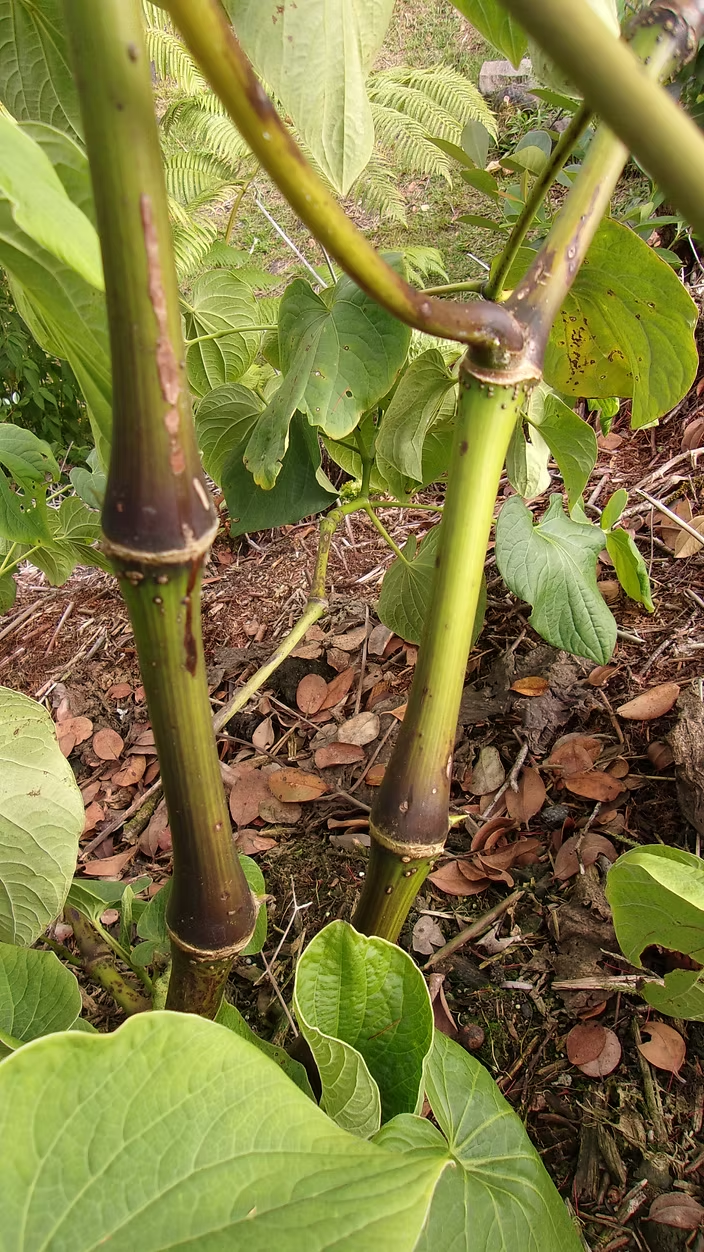
'Awa Mākea was the more common 'awa used by the makaainana or people of ancient Hawaii. Mākea grew abundant and was easy to cultivate. A dark purplish coloring at the node (aka) bottoms of each stem (kuau) quickly turns into a olive greenish color as it fades up to the next aka of the next higher internode or punapuna. To better explain this, at each top and bottom knuckle of the long internodes, there is the knuckle line that divides the knuckle joint or aka into top half and bottom half. At the top half of each knuckle is where the dark purplish color will be noticeable. On the bottom section on the same knuckle's half line, there will be dark spots termed Kikohukohu or pu'upu'u on the greenish stem of the lower punapuna. Older stalks have longer punapuna. The piko of the lau is green. The punapuna can be a foot long on older plants.

Photo: Chris Allen
It has been known that Mahakea is a close relative to the ‘awa from Omoa in Fatu Hiwa, Te Henua Enata. There were some old growth Mahakea plats found in Puna areas that were from very old plantings in the forest. These old Mahakea were huge in girth and the internodes were very long, with the long nodes being dull brown and grey in color. The long internodes were as thick as a forearm in size. Being grown under the forest canopy, the awa itself was not as potent as one would think, probably due to its limited absorption of sunlight, as ‘awa need a lot of sun to have good growth and strong roots.
Writing in the 1860s, Hawaiian historian, Samuel Mānaiakalani Kamakau (born in ca. 1815) wrote that: ‘Awa was one of the choice foods of the planter. ‘Awa is a handsome plant, with nicely rounded leaves and stems and shiny jointed sections. . . . ‘Awa grows well on lands with plenty of rain, and on warm lands< From of old there are places made famous by the intoxicating quality of their ‘awa, such as Ko‘uko‘u on Kauai, Hena on Oahu, Lanakila on Maui, and Puna on Hawaii. In places where wauke and dry taro are planted, ‘awa may also be planted. These plantings together with those of bananas and sugar canes, were the pride of the farmer. . . . It takes from two to three years for ‘awa to mature, and it will keep on growing for many years and be a bequest to one’s descendants. [Kamakau 1976:41- 42]


Comments