
'O Ko'oko'olau Ke Ku'ia

Updated: Sep 10

Kii: Koolau Watershed Foundation
The families of Koʻolaupoko were known for their steadfast skill in lua fighting. Both kāne and wahine were proficient in the many techniques and strikes of this ancient Hawaiian practice. The Koʻolau area of Oʻahu is still famous for its rain and its loʻi, or wetland kalo patches, which have existed for hundreds of years.

Kiʻi: Dietrich Varez
The ʻōʻō, or digging stick, was an essential farming tool used by all mahiʻai (farmers) in Koʻolau, Oʻahu. The lands of Koʻolaupoko are noted in history for their famous freshwater kalo fields, or loʻi kalo. The traditional ʻōʻō was used to dig holes in the soil for planting huli (young taro stalks), uprooting trees and weeds, removing stones, and serving as a basic digging staff. Some aliʻi, or chiefs, such as Kamehameha and Kekūhaupiʻo, also farmed large patches of ʻuala (sweet potatoes) and kalo with their own ʻōʻō. These chiefs and farmers were also highly trained warriors, skilled in lua warfare and battle strategy.
The ʻōʻō were crafted from durable, dense woods such as kauila, uhiuhi, koaie, ʻūlei and other hardwoods, including alaheʻe for the people of Puna. People of various localities used the natural resources available in their own areas. If they sought stronger, denser wood for their digging sticks, they traded or traveled beyond their lands to obtain their desired hardwood. Each end of the ʻōʻō was carefully shaped into a blade-like spade. The blades were then heated, blackened, and tempered over smoke and fire to strengthen the wood, allowing them to withstand rocky soil while resisting splitting and chipping. Kukui oil was rubbed into the wood to repel moisture and prolong its life against the natural elements. These ʻōʻō varied in length but were generally made to match the height of the person for whom they were carved. Each finished piece was given a name, as it became a personal and treasured part of one's ʻohana. These ʻōʻō became family heirlooms passed down through generations. If they were later used as weapons, they held even greater value within the ʻohana.
During times of war, the ʻōʻō became more than an agricultural tool—it also served as a formidable fighting staff. Because of its dual purpose, Hawaiians adapted its design and use into a dedicated weapon known as the kuʻia. The kuʻia became the traditional fighting staff of practitioners of lua.
A ku'ia is a traditional Hawaiian close-combat weapon used in Ka-laau. Its primary purpose is striking, thrusting, parrying, and controlling distance. Skilled practitioners develop precise footwork, timing, and weapon control over many years.
Some movements that appear to be "spinning" include:
-Grip transitions, where the ku'ia rotates in the hands, to quickly present either end of the striking blade (lau).
- The kulana or foot work is a important part of fighting, more so than the hand work.
-Circular motions, used in demonstrations to display control and dexterity.
-Feints, where small rotations and changes of angle can disguise the intended line of attack.
These are controlled, purposeful movements rather than fast twirling for show. Excessive poniu ana ( spinning ) can leave the wielder vulnerable and is generally not a feature of effective fighting technique.
He upu kahiko mai na kupuna mai ao Koolaupoko
Traditional K.K. Ku'ialuaopuna
Hoomimilo i ka lau a ka ui
Ka laau o ka mahi
Poniuniu i ke Kiliua o Kane
Ka makani pokaakaa
Ke oili mai la ka ua kaalelewa
I ka ai i ike ole ia
Aue! Hina-kupu-ia
Spin the leaf of the skilled one
The stick of the farmer
Twirling in the winds of Kane
The spooling wind
The circular rain is present
In the strike that is not seen
Auwe! The sprout has fallen
The above upu has some kaona in it that is not explained in detail. Use your imagination to find the answer. This is a kind of play on words that will find the reader if it's meant to!
According to the oral traditions preserved within our Hawaiian lua practice, when the people of Kaʻū and Puna on Hawaiʻi Island voyaged to Aotearoa many centuries ago, they carried their kuʻia with them. These staffs continued to serve as both farming implements and weapons. Over time, the Māori further refined the kuʻia in both design and function, developing it into the taiaha. This traditional account has been handed down through generations within certain families.
A traditional Kuʻia made from kauila.

Kii: Ku'ialuaopuna
One historical note: The statement that Hawaiians from Kaʻū and Puna carried the kuʻia to Aotearoa and that it evolved into the taiaha reflects a specific oral tradition.
This upu below was passed down through our ohana of Koolaupoko. The upu is a chant for a special fighting staff or ku'ia of old. It was said that this particular ku'ia was reddish/black in color, and when used in battle, it overcame all opponents. Could it be this ku'ia was made from the Kauila wood from the uplands of Koolaupoko? Perhaps the kauila log was brought in from another locality. This upu mentions certain localities known to the area's ohana. (Diacritical marks were added for reader clarity, but are not necessary for those familiar with the language.)
Traditional K.K. Kuʻialuaopuna
E Ko'oko'olau e
Ano aʻe nei ka manaʻo
Ma ka pali lele ʻiwa
Ma uka aku o Palikū nō au
A ka luna o Mo'okapuohaloa
Noho au me Kānehoalani
Ke aliʻi kapu o uka
Pā mai ke alo iā Holoholopali
Ka makani a ke kua loloa
Makehewa aku lā e naue i ke kai
Ke kai e pōuli nei
'Inoʻino ʻo Koʻokoolau e
Ke kuʻia a ka ua
E inu i ka wai a Kāne
Ka ua loku o Koʻoko'olau
Ku'ia ana iāia nei
Ka ʻōʻō a Ko'olaupoko
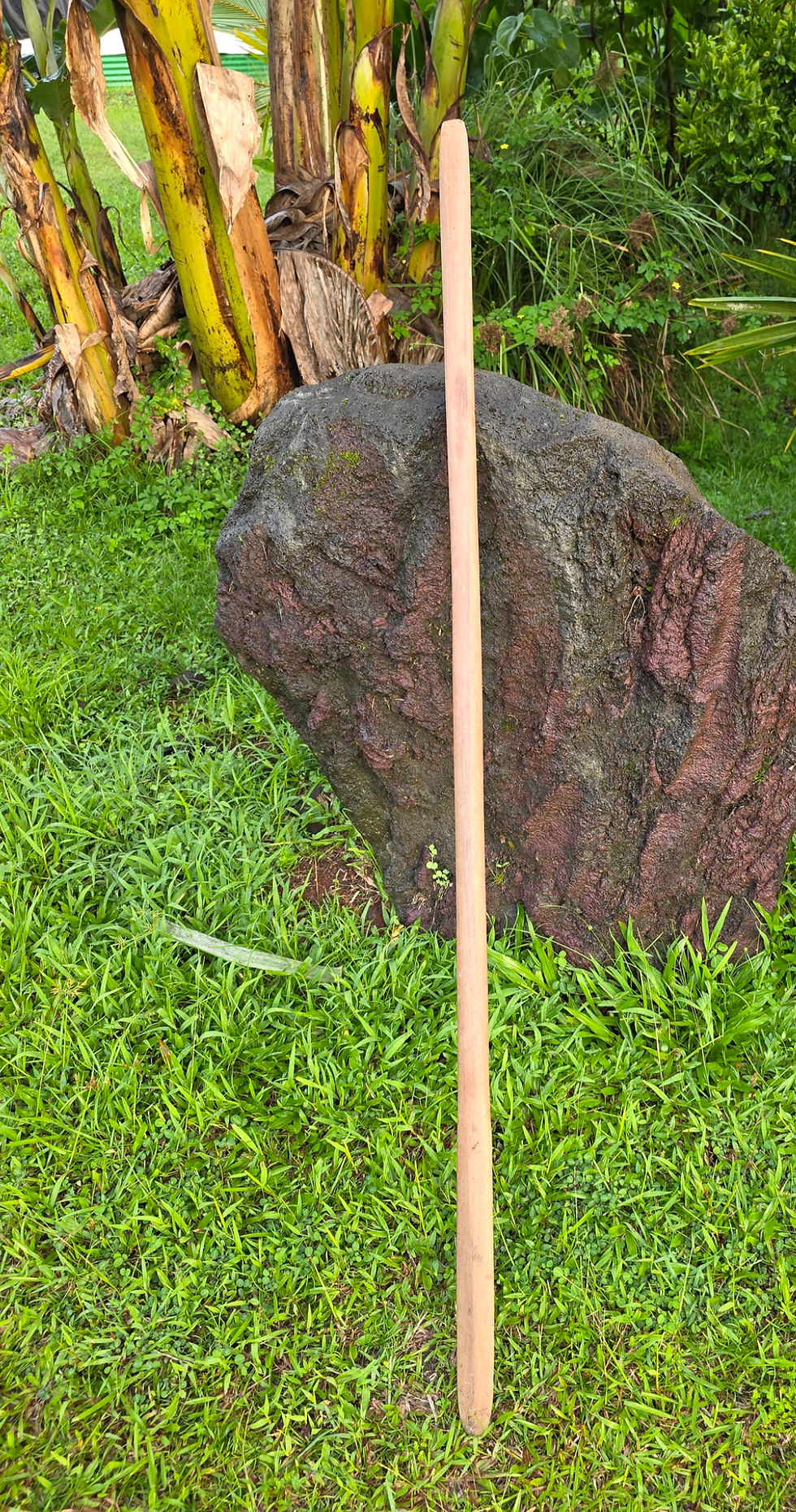
Kii: Ku'ialuaopuna
Oh Ko'oko'olau
The mind is at peace.
Upon the cliffs where the ʻiwa birds soar.
I stand in the uplands above Palikū
Above Mo'okapuohaloa
There I dwell with Kānehoalani,
The sacred chief of the uplands.
My face is touched by Holoholopali,
The running wind of the long ridge.
It is unwise to journey toward the sea,
For the lowlands grow dark.
Koʻoko'olau is stirred into turmoil.
The fighting staff of the rain.
Drink of the waters of Kāne.
The storm-filled waters of Koʻoko'olau
For you will cause anguish
The digging stick of Ko'olaupoko!


Comments